Pension Carry Forward
tl-4.jpg

Pension carry forward is a useful tool for pension planning. Once an individual has fully utilised their current tax year’s allowance, one can go back and utilise the unused pension allowance from the previous three tax years, starting with the oldest first. ​Potentially, this enables one to make quite a large pension contribution in a given year. Care needs to be taken on various issues, especially having sufficient ‘earned income’ for the large pension contribution. ​

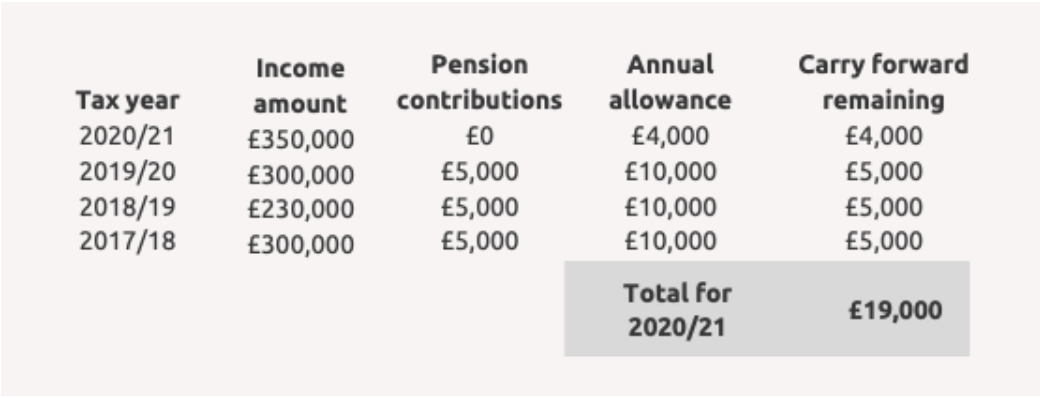
Here is an example of carry forward at work (assuming an individual  has the standard annual allowance): 

 
Screenshot 2020-07-23 at 09.19.23.png
 

Nothing contained in this article constitutes or should be construed to constitute investment, legal, tax or other advice. The information contained in this article shall in no way be construed to constitute a recommendation with respect to the purchase or sale of any investment.

Income Protection
tl-2.jpg

According to the Association of British Insurers, every year 1 million people in the UK find themselves unable to work due to a serious injury or illness. Although many of us would like to think “that will never  happen to me” or “it is not something I am worried about at the moment”, it is of course often only seriously considered in a moment of hindsight when it is too late. A large amount of employed individuals tend to benefit in some way from their employer in times of need, but for those who are self-employed it is left to you to personally organise any cover that you may need. 

Income Protection​ 

Income protection, (sometimes known as permanent health insurance), insures part of your earnings against illness or accidental injury. It ensures you continue to receive a regular income until you retire or are able to  return to work. ​It is not possible to insure yourself for your entire gross income; insurers feel that you need some incentive to get back to work! Income protection is usually based on a percentage of your earnings; up to 60% is the norm. 

Life Cover​ 

The most basic type of life insurance is called term insurance. With term insurance, you choose the amount you want to be insured for and the period for which you want cover. ​If you die within the term, the policy pays out to your beneficiaries. If you do not die during the term, the policy does not pay out and the premiums you have paid are not returned to you. ​Family income benefit is similar to the above, with the slight difference that the insured amount would be paid monthly/annually for the term of the policy rather than one big lump pay out. 

Nothing contained in this article constitutes or should be construed to constitute investment, legal, tax or other advice. The information contained in this article shall in no way be construed to constitute a recommendation with respect to the purchase or sale of any investment.

The Big Five
DSCN5437.jpg

Investors love good stories. In recent years, many of these stories have centred around innovations that have fundamentally changed the way we live our lives. Some examples might include the release of the original Apple iPhone in 2007, the delivery of Tesla’s first electric cars in 2012 and the launch of Amazon Prime’s same-day delivery service in 2015 . No doubt, many of you will have had conversations with friends and family around the successes, failures, and prospects of some of the world’s largest firms and the goods and services they offer. In this note, we take a deeper look at the ‘Big Five’ tech companies – Amazon, Apple, Alphabet (Google), Facebook and Microsoft – through the lens of the long-term investor.

In what has been a turbulent year thus far, some larger firms have come through the first - and hopefully last - wave of the ongoing pandemic relatively unscathed. Those investors putting their nest eggs entirely in any combination of the ‘Big Five’ would appear to have done astonishingly well relative to something sensible like the MSCI All-Country World Index, which constitutes 3,000 of the world’s largest firms . At time of writing, Amazon’s share price has fared best, increasing 75% since the beginning of the year.

 Figure 1: The 'Big Five' have held up well so far this year

Data source: Morningstar Direct © All rights reserved. Returns in GBP from 01/01/2020 to 22/07/2020.

Data source: Morningstar Direct © All rights reserved. Returns in GBP from 01/01/2020 to 22/07/2020.

These types of firms tend to struggle to stay out of the headlines for one reason or another. Perhaps as a result, many of the investment funds found in ‘top buy’ lists - such as the one on AJ Bell’s Youinvest platform - have overweight positions in one or more of these stocks. The final column in the table below shows the weight of each ‘Big Five’ stock as it stands in the MSCI All-Country World Index.

If an investor were to adopt a purely passive investment strategy that owned each company as its proportional share of the world market, the final column would be that investor’s top 5 portfolio holdings at time of writing. Many of today’s most popular funds are making big bets on one or more of these companies, anticipating that the past will repeat itself moving forwards.

Table 1: AJ Bell's top traded funds in the past week

Data source: Morningstar Direct © All rights reserved. AJ Bell for top traded funds between 15/07/20 – 22/07/20.

Data source: Morningstar Direct © All rights reserved. AJ Bell for top traded funds between 15/07/20 – 22/07/20.

Sticking to the long-term view

The challenge for these managers, and others making similarly large bets, is that these are portfolios that will be needed to meet the needs of individuals over lifelong investment horizons, which for the vast majority of people means decades, not years. With the benefit of hindsight, managers who have placed their faith in these firms have stellar track records since Facebook’s IPO in 2012, as the table below highlights.

Table 2: ‘Big Five’ performance since Facebook’s IPO

Data source: Morningstar Direct © All rights reserved. Returns from Jun-12 to Jun-20.

Data source: Morningstar Direct © All rights reserved. Returns from Jun-12 to Jun-20.

An interesting exercise would be to investigate the outcomes of these firms over a longer period of time, for example 30-years seems more prudent. This is somewhat difficult given that 30-years ago, 3 of these firms did not exist, Mark Zuckerberg was 6-years old, Apple came in at 96th on Fortune’s 500 list of America’s largest firms and Microsoft had just launched Microsoft Office .

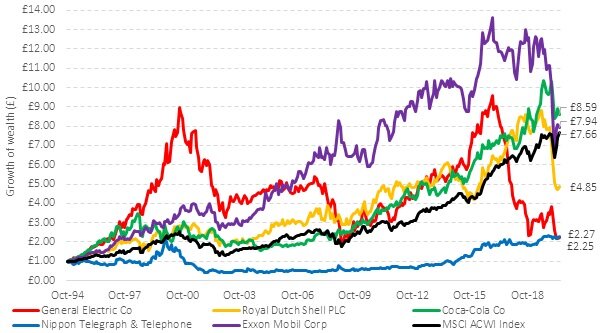
A partial solution to this problem is to perform the exercise from the perspective of an investor in 1996, which is the start of Financial Times’ public market capitalisation record . The ‘Class of 96 Big Five’ consisted of General Electric, Royal Dutch Shell, Coca-Cola, Nippon Telegraph and Telephone and Exxon Mobil. The chart below shows the outcomes of each firm over the past 26-years. A hypothetical investor with their assets invested in either Coca-Cola or Exxon would have just about beaten the market over this period, those in Royal Dutch Shell, Nippon Telegraph and Telephone and General Electric were not so lucky.

This experiment is illustrative only, one look at the chart below is enough to see that almost no investor would want to stomach the roller coaster ride they would have been on in any one of these single-stock portfolios.

Figure 2: The winners do not necessarily keep winning

Data source: Morningstar Direct © All rights reserved

Data source: Morningstar Direct © All rights reserved

Summary

The beauty of the approach you have adopted is that judgemental calls such as these are left to the aggregate view of all investors in the marketplace. No firm is immune to the risks and rewards of capitalism; be it competition from Costco or Walmart taking some of Amazon’s market share, publishing laws causing Facebook to apply heavy restrictions on its users or some breakthrough smartphone entering the marketplace that is years ahead of Apple – remember Nokia?

Rather than supposing that firms who have done well recently will continue to do well, systematic investors can rest easy knowing that they will participate in the upside of the next ‘Big Five’, the ‘Big Five’ after that and each subsequent ‘Big Five’. Those who can block out the noise of good stories and jumping on bandwagons are usually rewarded in this game.

Figure 3: Your eggs are in many baskets

next big 5.png
Source: Albion Strategic Consulting. For demonstrative purposes only.

Source: Albion Strategic Consulting. For demonstrative purposes only.

Risk Warning This newsletter does not constitute financial advice. Remember that your circumstances could change and you may have to cash in your investment when the value is low. The value of your investment and any income from it can go down as well as up and you may not get back the original amount invested. Past performance is not necessarily a guide to the future. If you are in any doubt you should seek financial advice.
Tapered Annual Allowance

The tapered annual allowance can be quite complicated to get your head around. We've put together a simple example to show how it works.

The table below aims to illustrate an individual affected by the  tapered rules: 

 
Screenshot 2020-07-22 at 15.20.26.png
 

The tapered annual allowance rules kicked in on 6th April 2016, when those with taxable earnings over £210,000 per annum were limited to pension contributions of £10,000 gross each tax year. ​This was a controversial piece of legislation and also  quite complicated.  The rules were altered from 6th  April 2020, whereby those earning in excess of £312,000 are now limited to an annual allowance of £4,000. ​This has made planning for self-employed individuals quite tricky, especially for those that have a tax year end of 31st March each year. ​Some good news, the carry forward rules still apply to those affected by the taper. 

Nothing contained in this article constitutes or should be construed to constitute investment, legal, tax or other advice. The information contained in this article shall in no way be construed to constitute a recommendation with respect to the purchase or sale of any investment.

Mitigating an unknown future
eye4Colour-march10-6513.jpg

One of the hardest concepts to grasp in investing is that a ‘good’ company is not always a better investment opportunity than a ‘bad’ company. If we believe that markets work pretty well – not unreasonable given that few investment professionals beat the market over time - and that they incorporate all public information into prices pretty quickly and efficiently, all of the ‘good’ and ‘bad’ news should already be reflected in these prices.  A ‘good’ company will have to do better than the aggregate expectation set by the market for its share price to rise and vice versa.  If a ‘bad’ company is in fact a less healthy company, it may have a higher expected long-term return, as risk and return are related.  

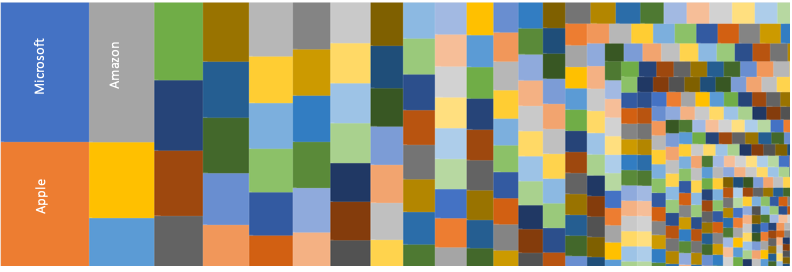
It is perhaps evident that if the market incorporates the aggregate forward-looking views of all investors, it becomes very difficult to choose which companies, sectors, and geographic markets are likely to do best, going forward.  In an uncertain world, where stock prices could move rapidly, and with magnitude, on the release of new information - which is itself a random process – then it makes good sense to ensure that an investment portfolio remains well diversified across companies, sectors and geographies.  Take a look at the chart below that illustrates how deeply diversified a globally equity portfolio can be.

 Figure 1: If you do not know which stocks are going to outperform well, own them all

Source: Albion Strategic Consulting. Data: Morningstar Direct © 2020. All rights reserved.

Source: Albion Strategic Consulting. Data: Morningstar Direct © 2020. All rights reserved.

The concentration risk in the US’s S&P500, is quite different.  

Figure 2: The US’s S&P500 is increasingly concentrated in a few names. 

Source: Albion Strategic Consulting. Data: Morningstar Direct © 2020. All rights reserved.

Source: Albion Strategic Consulting. Data: Morningstar Direct © 2020. All rights reserved.

Given that all the future promise of a company is already reflected in its price today, it is quite a risk betting a large part of your assets on just a few names, concentrated, for example, in the technology sector.  The top 8 technology stocks in the US now have a larger market capitalisation than every other non-US market except for Japan.  Dominance of companies, sectors and markets ebb and flow over time.  Who is the next Amazon?  What regulatory pressures could these dominant companies face?  Is Donald Trump’s recent rage against Twitter the start?  No-one knows.  By remaining diversified, you will own the next wave of market leaders as they emerge and dilute the impact of ebbing companies.  Whilst it is always tempting to look back with the benefit of our hindsight goggles and wish we had owned more (take your pick), US tech stocks, other growth stocks, gold etc., what matters is what is in front of us, not what is behind us.  

‘The safest port in a sea of uncertainty is diversification.’

Larry E. Swedroe, Investment Author

Risk Warning This newsletter does not constitute financial advice. Remember that your circumstances could change and you may have to cash in your investment when the value is low. The value of your investment and any income from it can go down as well as up and you may not get back the original amount invested. Past performance is not necessarily a guide to the future. If you are in any doubt you should seek financial advice.

Should we be talking about inflation?
DSCN5145.jpg

What is the impact of this pandemic on my investment portfolio? And what can you do to protect your future wealth?

As always, I will remind you we cannot predict the future. That is not our job. But what we can do is try and find similar issues in the past and see what strategy we can adopt today.

I have just finished reading ‘Dying of Money’ which was written by Jens Parsson. It tells the history of the German inflation after World War I and the US inflation after World War II. How they happened and what you can do to protect your wealth from events like this. The interesting one for me was the German inflation.

The Germans lost the war, as we know, but based their finances leading into the war and during the war on the basis that they would win. War was followed by reparations and then the Spanish Flu pandemic. The Germans broke with the gold standard and entered a period of money printing. Initially this led to a boom in the economy and very little inflation to speak of, but suddenly inflation got a grip and in a very short period the German Reichsmark became worthless. You could order a cup of tea and by the time it was served to you it was 20% more expensive.

After WWI, the Reichsmark was worth 23 cents to the $1. By the end of 1923, the Reichsmark was 1,000,000,000,000 to a $1! If you were a German depositor or a lender, you lost it all.

The money supply was the main issue. There were many reasons why the supply of money changed, but if you print more money, creating more notes, you make what you have worth less. To give a simple example. Let us say that the entire spare cash in the world is £1 and it is owned by one person. Let us also say that the only thing you can buy is a field of grass from someone else. There is nothing else to buy, just that one field of grass. Then the field, theoretically could be worth £1. If I now print another nine notes and give £1 each to nine more people as spare cash, we now have £10 in total available, but there is still only one field to buy. What is the field worth now? So, what can we learn from this:

  • The nine people who got £1 each for doing nothing probably felt very happy!

  • The first person to have a £1 saw his purchasing power reduce by 90%.

  • The owner of the field retained their purchasing value.

Okay, that is a simple example, but we know that borrowing and spending in the western world and the printing of money; quantitative easing (QE), has been going on for years now. This virus has pushed all this out even further. There is no deposit interest to speak of and a great way of clearing all this debt, which cannot possibly be paid back in any reasonable length of time, is probably a savage bout of inflation.

So, who came out okay from the German Inflation, US inflation and my example? It was the people who owned real assets; shares in companies, home owners, land owners. Holders of precious metals as well. People who owned stuff.

Who lost? Those people who owned the money; bank depositors, cash and lenders.

And the big winners; Government and borrowers. Debts gone – happy days!

I believe we are now in unchartered territory. But history has shown that while shares can go up and down in value (as we have seen in recent months), they can be a good store of future long-term wealth, offering some inflation protection. There has never been a stock market that has gone bust, but there are several currencies that have disappeared!

Max Tennant

Risk Warning This newsletter does not constitute financial advice. Remember that your circumstances could change and you may have to cash in your investment when the value is low. The value of your investment and any income from it can go down as well as up and you may not get back the original amount invested. Past performance is not necessarily a guide to the future. If you are in any doubt you should seek financial advice.

Tax Efficient Investments
St. Brides bay.jpg

A Venture Capital Trust (VCT) is a listed company, run by a fund manager, that invests in smaller companies that are not typically quoted on stock exchanges.  Investments in Venture Capital Trusts carry tax reliefs to encourage you to invest in these smaller, higher risk companies. By pooling your investments with those of other customers, VCTs allow you to spread the risk over a number of small companies.

Enterprise Investment Schemes (EIS) and Seed Enterprise Investment Schemes (SEIS) both encourage investment in qualifying early-stage and seed-stage growth-focused companies by giving investors handsome tax and loss reliefs.

tax 1.PNG

* This is increased to £2 million provided that anything above £1 million is invested in knowledge-intensive companies. There is no limit on CGT deferral.

^ Subscriptions into EIS can be used to defer capital gains (e.g. from selling a property). These gains can be from up to one year before and three years after the investment is made.  50% of a subscription into an SEIS can be taken off your realised capital gain. The SEIS subscription must be made in the same tax year that the gain is realised or the following tax year and then carried back.

VCT Example

See an illustration of a hypothetical VCT in the table below:

tax 2.PNG

Total profit = Tax Relief of £3,000 + Dividends of £11,600 = £14,600 less original cost of £10,000 = £4,600 net profit

In reality, we recommend diversifying VCT investments as much as possible, within the constraints of minimum investments that providers set. We would generally advise to commit to the strategy for a few years so that a portfolio of VCT providers is built up, which helps to reduce the overall risk level through diversification.

High Earners

If you have used up an annual or lifetime pensions allowance and your annual ISA allowance, then you may already be familiar with tax efficient investments such as a VCT, EIS and SEIS.  Listed below are some other reasons why you might benefit from investing in one of these tax-efficient products:

  • Offsetting tax on a capital gain

  • Selling a buy to let property

  • Sheltering investments from inheritance tax

  • Selling shares with an IHT problem

  • Extracting profits from a business

  • Managing chargeable events for single premium investment bonds

If you would like to discuss any of these scenarios or would like to hear more about our due diligence process for selecting VCT, EIS & SEIS investments, then please contact us.

William Buckley

Financial Planner

will@ifamax.com

N.B. It should be noted that VCTs, EIS & SEIS are very high-risk investments and you may lose your capital. It is recommended that investors take independent tax and financial advice from a qualified professional adviser before considering an investment. Tax benefits depend on personal circumstances and so are not guaranteed.

Nothing contained in this article constitutes or should be construed to constitute investment, legal, tax or other advice. The information contained in this article shall in no way be construed to constitute a recommendation with respect to the purchase or sale of any investment.


‘Vox populi’ and the wisdom of crowds

Many of you reading this short note will have, at some time, travelled down to Devon for a lovely summer break amongst the rolling fields, moors and beautiful beaches of this somewhat remote county.  

Only a few will have ventured into Plymouth, the famous naval seaport and home to Sir Francis Drake (that famous Elizabethan pirate who so vexed our Spanish friends by stealing their gold) and the site of the departure of the Mayflower with the pilgrims on board heading to America 400 years ago. Even fewer will know that it was the place of an amazing insight into the powerful nature of crowds, which provides us with a wonderful world picture of how markets operate.

In 1906 a Victorian gentleman named Sir Francis Galton attended a livestock fair aptly named The West of England Fat Stock and Poultry Exhibition in Plymouth. One of the many attractions at the fair was a guess the weight of the ‘dressed’ ox on display (similar to the game of guessing how many cookies are in the glass jar). The competition attracted 800 people all paying 6d (half a shilling) to write down their guess, name and address on the back of the ticket. The nearest guess to the actual weight would win a prize. The fair, as you can imagine, attracted many sorts, from the general public (old and young) to farmers and butchers.  

Being a statistician, amongst many other things, Galton bought the used tickets off the stall holder. Of the 800, 787 were usable. Back home he analysed the guesses and published his finding in Nature, March 7, 1917 in an article titled ‘Vox Populi’. His remarkable finding is illustrated below.  

Figure 1: Guessing the weight of the ox – the ‘crowd’ got it more-or-less spot on.

The Ox.png

Source: Albion Strategic Consulting

The range of guesses was wide (-133 lbs. below the average to +86 lbs. above it), the participants were varied, and the numbers involved were quite large. The ‘crowd’ in aggregate showed ‘wisdom’ compared to its individual participants.

This story provides a great insight into how modern financial markets work. The markets are made up of many players, from individual DIY investors, day traders, stockbrokers, hedge funds, fund managers, sovereign wealth funds, endowments and other institutional investors. Each investor holds their own view on the future prospects for a specific security, such as the price of BP or Apple shares. Some will like a stock and others not. They cannot both be right.  

The market – given all the information available to it – settles on an equilibrium price for every stock. This price will move, sometimes dramatically, as we have seen recently as the ‘market’ reaches a new equilibrium price, given the new information that it has collectively processed.

At times like these, some investors are prone to running ‘what if’ scenarios in their heads such as: ‘if companies are in trouble because their revenues have been cut off, then they will renege on their property lease terms and the landlords will suffer.  It seems likely that things will get worse over the coming weeks. If property landlords are in trouble that might lead to problems in the banking sector’. It all sounds plausible. They may then be tempted to sell out of property or banks or even equities altogether. The crucial mistake is that they forget that they are not the only person to have thought this through and these very sentiments and views are already reflected in the current price of listed commercial property companies, bank stocks and the markets in general.  

Markets will move again – down or up – based on the release of new information, which in itself is random. Second guessing random events is futile. You may make a guess and be lucky but that is speculating not investing. Accepting the ‘wisdom’ of the market helps us to challenge ourselves as to whether we really have superior insight relative to everyone else. It seems unlikely. As Charles Ellis, the wise sage of investing from the US, states:

‘In investing, activity is almost always in surplus’.

Activity based on guessing – particularly when it relates to shorter-term issues that sit well within your true investment horizon – is best avoided.

Next time you pass Plymouth on the A38, reflect on one of its great historical events, The West of England Fat Stock and Poultry Exhibition of 1906. 


Risk warnings:

This article is distributed for educational purposes and should not be considered investment advice or an offer of any security for sale. This article contains the opinions of the author but not necessarily the Firm and does not represent a recommendation of any particular security, strategy or investment product.  Information contained herein has been obtained from sources believed to be reliable but is not guaranteed. 

Past performance is not indicative of future results and no representation is made that the stated results will be replicated.

Errors and omissions excepted.

The new Tapered Annual Allowance rules
Nevern Estuary.jpg

For those who may well have missed the details of the budget, as COVID has usurped all other news.  We have been writing this piece annually and this year is no exception, with significant changes to add further complexity to pensions in the Chancellor’s Spring budget. 

Between 2010 and 2011, the pension annual allowance fell from £255,000 to £50,000 and then dropped to £40,000 in April 2014.  The tapered annual allowance rules kicked in on 6th April 2016, when those with taxable earnings over £210,000 per annum were limited to pension contributions of £10,000 gross each tax year.

However, one of the groups that was most effected by the taper was the NHS. This has resulted in some doctors receiving high tax bills or seeing their future pension benefits reduced, making many reluctant to take on additional overtime.  To counter this in the Budget the Chancellor announced the following changes:

  • The two tapered annual allowance thresholds (threshold and adjusted) have each been raised by £90,000. 

  • Under the budget changes, for those on the very highest incomes, the minimum level to which the annual allowance can taper down will reduce from £10,000 to £4,000 for anyone with earnings of £312,000 or more.

The table below shows the new Tapered Annual Allowance (TAA).

table 1.PNG

The good news is that there is still one relief in place to help those affected by TAA, this is known as carry forward.

The table below shows how a high earner who has been paying £10,000 a year into their pension and the carry forward available to them in 2020/21.

table 2.PNG
  • Make sure you avoid an annual allowance tax charge by reducing your monthly pension contributions.  If like many, you were previously making monthly pension contributions of £667 (net) to cover your £10,000 annual allowance (gross) - be careful if your adjusted income in now in excess of £300,000 as the taper reduces even further to just £4,000 per annum for incomes of £312,000 or more.

If you would like to discuss pension contributions and retirement plans, in light of these changes, please contact us.  We are here to help you get the most out of your pension and find alternatives for retirement savings if necessary.

William Buckley

Financial Planner

will@ifamax.com

Risk warning: This does not constitute financial advice.  The value of your investment and any income from it can go down as well as up and you may not get back the original amount invested. Past performance is not necessarily a guide to the future. If you are in any doubt you should seek financial advice.                                                 

Covid-19. What should you do in this market downturn?

In my time as a financial professional, I have seen many downturns, some more significant than others. I started work in this world of finance in May 1988 and since then these are the ones that have stuck in my head:

1990 Recession (Personally very painful - anyone with a mortgage at that time will never forget it!)

1997 Asian Banking Crisis (Debt, too much of it)

1998 Collapse of Long-Term Capital Management (Overconfidence)

2000 Dot-com Crash (Some stuff way too expensive)

2008 Banking Crisis (These happen periodically and will again)

2012 Grexit (Should have happened, but didn’t)

2016 Brexit (Should not have happened. Mostly felt in currency so far)

2020 Covid-19 (We could add oil to this and a recession - possibly)

Problems, obstacles, disasters, however we want to call them, they always happen and always will do. They are so difficult to predict in advance. As an investor, you should always expect a significant event every three or four years. Is this Covid-19 significant yet? Will it become more significant? I don’t know.


So, from an investment perspective, what should we do now?

Nothing. For now, we say you should do nothing. Why? We cannot predict the future. We can only tell you what we know today and what happened yesterday. We cannot tell you much about tomorrow, other than it will come. We don’t know tomorrow’s price for anything!


Are you retired, or about to retire?

What we will have done already, is to make sure that if you need an income in retirement, either now or soon, don’t worry. Our portfolios hold short-dated bonds (this is typically money lent to high quality governments). These are the defensive assets and they will now be appreciating in value. While ‘investors look for a safe haven’ as the media likes to describe it, you’ve already got it built in.

During the banking crisis of 08-09 (the biggest event of those listed above, so far), these short-dated bonds enabled our clients to:

1. Draw money in retirement without touching any real assets (shares and property).

2. And when stock markets got very cheap (March 2009), we were able to sell some of these bonds and buy more shares at bargain prices.

Put simply, if you are due to retire in the next few years, or you are already retired; by holding an investment portfolio that contains these short-dated bonds within it as defensive asset; you should be fine. But if you are not sure please give us a call, we welcome it. 


Are you saving for the long term?

I think the answer is in the question. Long term, equity markets have delivered great returns. If your investment time horizon is 10, 20, 30 years or more. Don’t worry. All the events I mentioned before end up looking like mere blips when you look backwards. I am 54 now (ouch) and the 1990 recession was horrible at the time, but looking at it now:

If I invested £1,000 in the FTSE All Share in 1988 (when I started work in finance), by the end of 2018 it would be worth £11,882 (30 years on).

If I waited until the 1991 to make the same investment, and thus avoid the market downturn on news of a recession that will occur in the future (market fell 17% in 1990), I would now be sitting on £9,049

Source: Dimensional Fund Advisers Matrix Book 2019

So, keep investing regularly and ignore the short-term noise. Don’t turn yourself into a short-term investor if you have a long-term investment horizon.


But there is one big difference!

All the other falls had nothing to do with your health, or the wellbeing of your family, friends and other loved ones. Follow the Government advice and we hope everyone stays safe and well.

How to be more disciplined about retirement saving

One of the reasons why people find investing harder than they should is that human beings are hard-wired to focus on the here and now. We’re much more concerned about immediate threats than longer-term dangers such as failing to save enough money for retirement.

In this video, Professor Arman Eshraghi, an expert in behavioural finance at Cardiff Business School, explains how to develop a more disciplined approach to investing for the future.

Ifamax -- Protecting your wealth for a secure retirement www.ifamax.com -- Connect with us -- LinkedIn: https://www.linkedin.com/company/ifamax-limited/ Twit...

You will find plenty of helpful videos like this one in our Video Gallery. Why not have a browse?

Video transcript:

Human beings are hard-wired to focus on the present.

We’re finely attuned to the immediate threats around us. What we’re not quite so good at is dealing with long-term dangers, like not saving enough money for retirement. Professor Arman Eshraghi is an expert in behavioural finance.

He says: “When it comes to events that happen in the long-term, whether it’s going into retirement, etc. we don’t plan for them sufficiently because we don’t see them as sufficiently close.”

Thankfully, help is at hand in the form of financial technology, sometimes called fintech for short. The technology enables us to automate our retirement saving, so we put aside a set amount each and every month without even thinking about it.

Arman Eshraghi says: “Fintech applications basically can allow you to automate your decision to invest in the markets without much thinking, so you really make a decision once, you make a commitment once, and then effectively, the process of investment gets automated — let’s say, every 20th of the month.”

Starting to save early for retirement is very important. But we should also increase the amount we put away each month as our income goes up.

Committing to increasing our pension contributions as time goes by is another very valuable discipline.

Arman Eshraghi says: “Research by some economists in the US shows that there are techniques like “save more tomorrow”, so this is Richard Thaler, for example, who has talked about “saving more tomorrow”, which effectively means that you make the decision to invest a base level and then, effectively, you add to it a little bit every month. And without noticing the pain, let’s say. And then over time, this grows into a significant amount of investment which would then hopefully be a source of income for the long-term and for retirement.”

So, don’t give yourself an excuse to spend money that you should be saving for retirement. If you haven’t done it yet, automate your investing now.

It’s easy to do, and in the years ahead, you’ll be very glad you did it.

Picture: Aaron Burden (via Unsplash)

The benefits of mindful investing

There is plenty of evidence to show that mindfulness has a range of health benefits. But can it also help us to become better investors?

Someone who thinks so is the financial writer George Kinder, who has practised mindfulness for more than 50 years. In this video, he explains to Robin Powell how focussing on the present moment and being in touch with our feelings can help investors make more rational decisions.

Ifamax -- Protecting your wealth for a secure retirement www.ifamax.com -- Connect with us -- LinkedIn: https://www.linkedin.com/company/ifamax-limited/ Twit...

You will find plenty of helpful videos like this one in our Video Gallery. Why not have a browse?

Video transcript:

The last few years have seen a big increase in the popularity of mindfulness.

Mindfulness is a state of mind created by focusing on the present moment, while calmly acknowledging and accepting our feelings, thoughts, and bodily sensations.

George Kinder is a financial writer, and trains financial advisers. He has practised mindfulness for more than 50 years.

He says: “So it’s a training in paying attention. And you’re paying attention in here. You’re paying attention, in a way, to who you are. You’re paying attention to these moments where you feel wonderful, these moments where you feel frustrated, these moments where you feel fearful or anxious or guilty or shameful, which we all have as human beings.

“The primary practice that is taught in mindfulness is to really focus on the present moment, which as you know is impossible to do because it keeps disappearing on you. But what that does is that it makes you much quicker in the moment, much clearer in the moment, much more capable at a moment’s notice to focus and be present, so you’re really much more alert.”

One of the mistakes investors commonly make is they allow their emotions to get the better of them.

By making you more aware of your emotions, mindfulness can help you control them.

George Kinder says: “The most common pattern in investing is not to buy low and sell high, which is the smartest thing to do. The most common pattern in investing is that we all buy high, when everybody’s enthusiastic about something, and then we sell low when everybody’s pessimistic about something. So what happens, that’s driven by greed and fear. What mindfulness does is it creates more patience, more equanimity, more quietness, less reactivity. So you’re more able to be here, be present.

“My main recommendation would be to, if you aren’t doing mindfulness, get a practice going. And if you are, I would double your practice time. And I think the third thing is find an advisor who’s trustworthy, because they will help settle you down. They have listening skills inside of them and they’ll help settle you down so you don’t make foolish mistakes.”

Mindfulness isn’t for everyone. And although it looks easy, it actually isn’t. It requires plenty of practice.
But if you invest the time required to learn it, George Kinder says you won’t regret it.

Picture: Dingzeyu Li (via Unsplash)

Client Spotlight - Fiona Lewis
Fiona photo.jpg

Sustainable & responsible jewellery

March newsletter 2020

Could you give us a little introduction to yourself?

I am a self-employed designer/maker of Fiona Lewis Jewellery. I live in Chipping Sodbury, a pretty Cotswold market town that has independent shops, cafes, pubs and bars. It is well worth a visit for an afternoon out. I love the countryside in all winds and weathers, the peace and space provide my inspiration… my mind is constantly forming shapes and movement into designs, and probably a source for a lifetime of jewellery and some more!

When I am not working, I am walking, travelling abroad, sewing, gardening, socialising, and spending time with my fabulous partner David, who encourages me in everything I do. My son and daughter are both creative so family conversation is often about our next projects. I keep chickens, and Prudence the cat who has decided the feral lifestyle is not for her, she prefers my sofa and a warm lap.

Tell me about how you came to be a jeweller?

I attended a senior school where the pupils were all taught metalwork. I found my niche and was in my element during those lessons; forging, using the lathe, soldering and cutting, and unusually for me was top of the class. However, to my great disappointment, when the time came to select my options, I was informed Engineering and Metalwork was the ‘boys only’ option. I was disappointed to say the least but I stored in my mind some idea that one day I would revisit metalworking. In 2010 after quite a few decades of waiting for the right time, I booked an evening class in silversmithing. I learned to design and make jewellery and my passion for metalwork was reignited. Within 18 months, and due to popular demand from friends wanting to buy from me, I was selling my creations. I have continued to refine my skills, design, make and sell my jewellery in my online Etsy shop and through my Facebook page.

How do you define yourself?

I am a magpie for shiny metal, and beautiful stones but also have a passion for a sustainable, responsible approach to my business. The gold and silver I use is either recycled by my suppliers, or I reuse my customers’ gold to create bespoke pieces for them. I source diamonds and precious stones from ethical suppliers and use recycled materials in packaging.


Tell me about the evolution and range of your styles of jewellery.

I began by making jewellery that was inspired by nature and my love of the outdoors. Over time, I have concentrated on pure form, and more contemporary abstract shapes. Learning to set my own stones is a challenge, but also a delight, those are my hands that have touched each piece from start to finish. I make everything using traditional methods of silversmithing, using hand tools. I love the forged shaped look, and adding droplets of gold, the technical term for ‘droplets’ is an unromantic ‘granulation’. Adding the sparkle of my favourite diamonds and sapphires creates a unique, contemporary look in a piece.

What is the greatest recognition of your work so far?

I talk to my customers and like to have a feel for who I am making for… so my recognition is from them, their reviews and feedback. I think this review is one of my favourites so far:

“From the very moment I saw her work, I knew Fiona was the person I wanted to make a very special gift for my daughter. The communication between Fiona and myself was brilliant as she responded positively and instantly knew what I envisaged. Her patience and eagerness to supply me with a pendant that would match my idea was amazing; nothing was too much trouble. Once Fiona had confirmed all the details, she gave me a time frame and the pendant was made and dispatched within the time. It arrived securely packaged and beautifully presented in a gift box. The pendant is exquisite and has surpassed my hopes and wishes. It is a piece of art and will be treasured for years to come. If the reader needs someone with skill and vision, Fiona is this person”.


What can we expect next from you?

I will soon be learning to carve wax to create shapes to be cast. In my imagination I have a variety of beautiful, tiny birds that will become gold and silver jewellery, I am sourcing tiny black diamonds for little beady eyes, and peacock sapphires to flush set on wings.

My dream is to create a collection of kinetic jewellery and boxes with meaning; to celebrate life, a lost love, a friendship, special moment or emotion etc. I would incorporate a series of cogs or perhaps a chain to provide movement. Doors would open, hearts would spin and birds fly around the sun. Yes, there I go again…. Another lifetime and more of ideas!


Best of luck with your endeavours Fiona and thank you for being this months client in the spotlight.

If any other clients would like to feature in a future newsletter with a story, profile, charitable fundraising or discussion on a topic you would like to share please do get in touch.

Introducing Insignis Cash Management

All asset classes are important to us, and cash is just one of them. To enhance our service model, Ifamax has partnered with Insignis.  Insignis Cash Solutions is an innovative cash management solution that complements your asset portfolio by looking after your cash. 

Cash is different to your other assets due to its liquidity and return potential. This service allows you to get a better return than you would at a traditional high street bank, while still allowing you to determine what liquidity requirements suit you.

The great benefit of using this service is that it is done with a single sign in procedure, making it as easy for you as possible.

Insignis use a number of secure UK-based financial banks to invest your cash. All the banks used have FSCS protection, which is currently £85,000 per bank, per individual.   This gives our clients a variety of options, depending on the capital amount and term requirements.

The service is aimed towards those that typically hold high cash balances as the minimum account size is £50,000.


How clients will benefit:

  • Client remains the beneficial owner at all times

  • A single sign-up procedure, giving you access to multiple bank accounts

  • Interest rate monitoring and cash account management

  • The ability for Ifamax to manage the service on your behalf (if required)

  • View your live cash portfolio online

  • Their assets being safe and secure

  • Individuals, Companies, Trusts or Charities


How to decide whether to trust an adviser

It’s very important that you have absolute trust in your financial adviser. But how do you go about choosing one?

In this video, Herman Brodie, an expert on the adviser-client relationship, says the first priority is to establish that an adviser is thoroughly competent.

But, he says, whether you can trust someone or not is a very personal decision, and ultimately only you can decide whether a particular adviser is right for you.

You will find plenty of helpful videos like this one in our Video Gallery. Why not have a browse?

Video transcript:

Just as you need to trust your doctor, you also need to trust your financial adviser. Financial author and consultant Herman Brodie is an expert in adviser-client relationships. Trusting your adviser, he says, will give you much more peace of mind.

"So, if I trust my adviser or I trust my asset manager, the riskiness of the whole enterprise we’re doing together is actually diminished. So my level of anxiety is reduced. Now, a lot of bad things can result when we are overanxious about the engagements we are involved in. And financial markets are fraught with all of the kinds of things that we as human beings find the most disagreeable. And this often leads us to do precisely the wrong thing at the wrong time. Now if we perceive the whole riskiness of the engagement to be reduced because we trust the person who we’ve confided with our assets, then, of course, this brings an enormous amount of reduced stress for clients."

Sadly, some advisers in the past have proved themselves to be far less worthy of trust than others. If trust in your existing adviser has broken down, it’s very different to rebuild.

Brodie says: "So when you get advisers, for example, pushing products that are very expensive when there are cheaper alternatives, or because they are tied to a particular product issuer. Or even in medical professions, where doctors have been seen to be prescribing particular medicines because they are taking kickbacks from the pharmaceutical company. It’s evidence therefore that they are actually not acting in my interests at all, they are acting in their own selfish interests. And this damages the perception of benevolence. And those perceptions are very very difficult to recover."

Herman Brodie says there are two components to trusting an adviser. The first is a conscious decision: Is the adviser competent? The second is more sub-conscious: Does the adviser have my very best interests at heart? Ultimately, he says, you have to trust your gut instinct.

"So at least with the conscious part of that evaluation, in terms of, you know, the skills and training, and let’s say the fiduciary responsibilities that that adviser takes on board. On paper, that adviser must stack up, so the competence measure must at least be satisfied. But, whether you are going to perceive that person as benevolent or not, it’s largely non-conscious, I cannot tell you how you are going to feel about somebody.

"Who I’m going to be able to be open with is probably going to be somebody different to you. And as a consequence, you just have to go with your gut. There is no secret formula for identifying benevolence. Everybody sees benevolence in a slightly different place."

So, you should choose an adviser who is clearly competent, but also one who will put your interests ahead of their own. Only you can decide if someone ticks both boxes.

Picture: Zdeněk Macháček via Unsplash

Coronavirus Briefing

I cannot tell you how bad things will get in the future for this virus or tell you how much it will affect your investments. My advice as always is to simply sit tight. If it gets really cheap, there is a potential opportunity and we will advise accordingly.

I have produced a table below to show how world equity markets have performed in recent epidemic scares.


MSCI World Index: World epidemics and global stock market performance.

Source: Charles Schwab, Fact-set data for 1,2&3 month performance. Dimensional Matrix Book 2019 for That year and 1 year later. The MSCI Index captures large and mid-cap representation across 23 developed markets countries. With 1,646 constituen…

Source: Charles Schwab, Fact-set data for 1,2&3 month performance. Dimensional Matrix Book 2019 for That year and 1 year later. The MSCI Index captures large and mid-cap representation across 23 developed markets countries. With 1,646 constituents, the index covers approximately 85% of the free float-adjusted market capitalisation in each country.


So how should we approach the news about COVID-19, better known as the coronavirus. We know that human beings are finely attuned to what we see as an immediate threat. It’s how we evolved. But it isn’t always helpful.


What about the impact on your investment portfolio?

Stock markets fell heavily in the last few days and there’s no shortage of market “experts” in the media warning of further “turmoil” to come.

But the simple fact is that they just don’t know. Yes, coronavirus could develop into a global pandemic. Or it could blow over in a matter of months. In any event, predicting what impact all the different possible eventualities might have on the economy, let alone the financial markets, is nigh on impossible.


Focus on what you can control

A very important principle in investing is to focus on what you can control and let the rest go.

You have no control over coronavirus or the markets. Unless you’re a professor of epidemiology, don’t kid yourself either that you have any unique insight into how the virus might develop. And remember markets could go sharply up or down from where they are now for reasons totally unrelated to COVID-19.

But, if you’re anxious about the markets — and it’s a natural human reaction to be so — please feel free to give us a call.


If history teaches us anything, it’s that great investment gains go to those who are diversified, optimistic and patient. In other words, if you spread your investment bets widely, favour stocks and have a long-time horizon, good things should eventually happen.
Don't base your investment decisions on the economy

It seems logical to believe that the performance of a country's stock market is linked to the state of its economy. After all, if GDP growth is strong, company profits are good, and that should help share prices.

Economic prospects are even often used to identify which stock markets are likely to perform in future. If a country is experiencing positive GDP growth, then investors are encouraged to see it as a good place to put their money.

What the evidence reveals

Yet several studies have shown that this link is actually weak. A comprehensive analysis of 21 countries over more than 100 years by the authors of the book Triumph of the Optimists found mixed results between GDP growth and stock market performance.

An MSCI analysis in 2010 found similar results. Most notably, for the 60 year period from 1958 to 2008, Spain and Belgium enjoyed real growth in their economies of between 3% and 4% per year, yet the real returns from their stock markets over this same time were negative.

One of the clearest examples of the potential breakdown between a country's economic performance and that of its stock market has been Japan. Since 1989 the country has grown its economy at over 1.5% per year, yet the Nikkei 225 Index is still well below its December 1989 peak. That is a period of more than 30 years in which Japan's GDP growth has not been reflected in broad market returns.

A closer look

This doesn't only occur over the long term either. It can also be play out from year to year.

The tables below, which consider the last 90 years of GDP growth in the US, make this clear. On the left are the 15 calendar years during this period in which US growth was weakest, and on the right are the 15 years in which it was strongest.

Economics.png

What stands out is that in more than half of the worst years, returns from the stock market were still positive. In six of them, the S&P 500 was up more than 20%, even though GDP growth was zero, or negative.

Not quite as striking, but nevertheless noteworthy, is that even in some of the best years for the US economy, the stock market fell. Incredibly, in 1941, when GDP growth was 17.7%, the S&P 500 declined 12.8%.

Understanding the gap

It is clear from these studies that the state of a country's economy should not be seen as a guide for how its stock market is likely to perform. As MSCI notes, there are three main reasons for this.

“First, in today’s integrated world we need to look at global rather than local markets. Second, a significant part of economic growth comes from new enterprises and not the high growth of existing ones; this leads to a dilution of GDP growth before it reaches shareholders. Lastly, expected economic growth may be built into the prices and thus reduce future realized returns.”

Investors should therefore be cautious about basing their decisions on economic data. This has even been apparent in the UK over the past five years.

The story in London

Since 2014, the local economy has mostly staggered along at growth rates below 2%. Yet, the FTSE All Share Index has delivered an annualised return of 9.4%, which in today's low inflation environment is a real return of close to 8%.

If an investor had stayed out of the market due to fears around Brexit and the country's general lack of economic momentum, they would have missed out on this period of growth.

Similarly, those who argue that the US stock market is going to continue to show good returns almost always base their argument at least in part on the fact that the US economy is still strong. As history is shown in the case of Japan, however, a growing economy does not necessarily equate to good returns for investors on the stock market, particularly if share prices are already high.

Trying to guess which markets may or may not deliver the best returns in future based on the economic prospects of the country in which they are based is therefore not a way to investing success. Investors are far better off building a strategy diversified across markets that they can stick to no matter the economic environment, and reap the rewards over the long term.

Photo by Vlad Busuioc on Unsplash

For investors, patience is a virtue
From Little Things Big Things Grow_IFAMax.jpg

Two children decided to compete to see who could grow the most luxurious garden. Both Peter and Paula prepared the ground, laid down the seeds and watered the soil. Three years later, Peter’s garden had barely grown, while Paula’s flourished.

What was the difference? Peter was impatient. Coming back the next week after planting the seeds he was disappointed there was little movement. He decided to dig it all up and start again. Paula added water and fertiliser and waited.

This cycle continued over the years. Peter decided at one point there was not enough sun, so chopped down an overhanging tree. The soil dried up under the full sun and baked hard. Paula decided to leave well enough alone with her garden.

The difference in approach between these two aspiring gardeners is evident every day in the share market. Many investors, having assembled their portfolios, insist on fiddling. They respond to news, second guess themselves and churn their holdings.

The Peters of the investment world chase past returns, pick up on investment fashions and are impatient for quick results. The Paulas leave their asset to grow, knowing that compounding will do much of their work for them.

Of course, this isn’t to say the second group of investors are totally passive. They come back every six months or so and do some pruning in the form of rebalancing. They water, weed and fertilise the investment garden with new cash as it comes to hand.

But the more successful gardeners are systematic in their approach. They focus on the basic elements and what is within their control. For the most part, they let nature take its course. And they exercise discipline along the way.

This is part of a series of blog posts in which we use illustrative analogies to simplify the often-complex world of investing. Take a look at some of the previous articles below:

Pay less attention to weather forecasts

Why stick with a losing proposition?

Why you should ask the audience

Why overconfidence in investing can be dangerous

Generally speaking, it’s good to have a positive outlook on life. But too much optimism, or overconfidence, can be a problem, particularly when it comes to investing.

In this video, Lisa Bortolotti, Professor of Philosophy at the University of Birmingham, explains why investors need to be realistic.

Ifamax -- Protecting your wealth for a secure retirement www.ifamax.com -- Connect with us -- LinkedIn: https://www.linkedin.com/company/ifamax-limited/ Twitter: https://twitter.com/ifamax - Transcript - Why overconfidence in investing can be dangerous RP: Generally speaking, it's a good thing to have a positive outlook on life, and to be reasonably optimistic about the future.

You will find plenty of helpful videos like this one in our Video Gallery. Why not have a browse?

Video transcript:

Generally speaking, it’s a good thing to have a positive outlook on life, and to be reasonably optimistic about the future. It’s better for our health and mental wellbeing for a start. But there are potential pitfalls too. Lisa Bortolotti is Professor of Philosophy at the University of Birmingham and an authority on the dangers of overoptimism and overconfidence.

“I think, where you see the negative effect is where you have context, where things are so complicated that being optimistic about your competence or your performance leads you to making mistakes and taking too many risks. So, finance is an obvious case. Finance is very complicated. You need to take into account the relative value of different options and the idea that you will make the best decision because you’ve made a very good decision in the past where you tend to think your previous luck as skill makes you too confident about the decision you make and less likely to listen, maybe, to other people and take into account different factors.”

A tendency towards optimistic bias or unrealistic optimism is part of the human psyche. It’s the way we’ve evolved. Behavioural experts have identified different dimensions to it. One of these they refer as the Illusion of Control.

As Bortolotti explains, “The Illusion of Control is when something is happening and we witness the thing happening and we tend to think that we are actually interfering with what is happening and determining the outcome. I think, in the financial world it’s possible that we may think that we will be able to know whether a certain company will be successful or whether certain rates will go up or down. And this capacity, that we think we have to predict how things will go, will make us make decisions that are more bold and do not take into account other factors that we should factor in.”

Another aspect of optimism bias is the so-called Illusion of superiority. In other words, thinking we’re better than we actually are.

“The superiority bias, which is also called the 'Better Than Average Effect’, is the idea that we tend to think of ourselves as better than average - in a number of domains. So, we may think that we are more attractive, smarter, more generous as well. Now, The better than average effect has been observed across the board and it normally works in combination with the optimism bias to make us make predictions about the future that are too positive, too rosy, because if I think that I have a lot of skills and a lot capacities and I think that things that are negative will not happen to me, then I will think that I can control what happens in the future, and I can determine a future that is happy for me.”

Again, it’s good to be optimistic and confident to a point. In fact, you need to have a positive view of the future to invest in human enterprise in the first place. But be realistic, and don’t overestimate your ability to outperform other investors.

Picture: Benjamin Davies via Unsplash

Client Spotlight - Andy Humphries

Andy, his wife Sally and their son Jack, have been Ifamax clients since early 2018. After qualifying as an accountant following university, Andy then worked his way through the financial services industry as a sales and commercial director.

After becoming disillusioned and bored with corporate life Andy, Sally and a couple of friends set up their own financial claims business from their bedroom in 2004.

By 2008 they had 45 staff, a turnover of £7m and an average customer satisfaction score of 9.5 out of 10. It was this great feedback from customers that Andy notes as one of the most enjoyable parts of being in business.

When the time came to exit the business, they did consider selling but;

“thought the purchaser were unlikely to have the same customer focus that we did. We decided it better to bring in a couple of directors to allow us to take a step back and eventually wind the company down.”


So how has all this led to Andy running around in a 10kg Rhino suit?

One thing that defined me was that I was hugely overweight as a child and reached 18 stone at 17. I then lost 6 stone over a few months when I was 18. This was my biggest achievement in life (bigger than the business and running achievements).

Not only did it change my life completely and gave me confidence but also taught me that I had the determination to do the things I wanted to.

For this reason Andy sees running as massively important for both keeping off the weight he lost when he was young and as a continuing challenge for himself. After clocking up over 60 marathons and ultras all over the world for the last 30 years, he has now decided that it makes sense to challenge himself even further!

I am getting slower but still like to look for a new challenge. I’ve never run a marathon in costume and the rhino costume is iconic so it seemed an obvious step. I contacted the charity in August last year to apply to run for them. Since then I have learned a lot more about the plight of the rhino. It staggers me that in this day and age we are still cruel to and slaughtering animals for totally unnecessary reasons and monetary gain.

Rhino horns are used in traditional medicine and as a sign of wealth. We have eliminated 95% of rhinos and 3 of the rhino species are on the endangered list. By running in the marathon and doing talks in schools I hope I can do a little bit to raise awareness of the rhino and what’s being done to stop rhinos, and other animals facing a similar plight, becoming extinct

When Andy first sent over pictures of him wearing the suit itself we were all surprised at how big, heavy and uncomfortable it looked and it appears that after taking it out for a practice trot last week he has confirmed it is all three.

It moves around a lot, has limited visibility and is big and hot. It changes your running style and you have to hold the head when you to keep it still which quickly makes your arms ache!! I really hope that it’s not too warm on marathon day. Little wonder the charity said not to run too much in it before London because it might put me off doing the marathon itself.

Andy hopes to raise an impressive £5,000 for Save the Rhino International and all at Ifamax wish him well in trying to reach that target, the many training runs to come and indeed the big day itself on Sunday 26th April.

If you would like to read more information on Andy’s fund raising and ongoing training efforts please feel free to visit his Just Giving page by clicking the button below:


Good luck Andy and thank you for being our first client in the spotlight.

If any other clients would like to feature in a future newsletter with a story, profile, event or indeed some charitable fundraising of your own please get in touch.