Is your limited company suffering from cash drag?

It is not uncommon for limited companies to build up sizeable cash balances. Most owners opt for a low salary, high dividend and regular employer pension contribution type strategy. But what about companies in the fortunate position of being able to accommodate this and still have large cash balances?  

A route most take is the ‘path of least resistance’ i.e. leaving it all in the company bank account. This is by far the easiest option and arguably the safest. The main drawback of this is that interest rates are currently very low and have been for many years now. When you factor in inflation you may be in a position of losing money in ‘real’ terms. The chart below aims to illustrate this: 

Assumptions used:

Initial investment amount £1,000,000

Long term cash return: 1.5% per annum

Long term inflation rate: 2% per annum

Long term investment return: 5% per annum

You can clearly see the issue of holding cash that is consistently generating a return that is less than the rate of inflation.


What can business owners in this position do?

  • Nothing. Just accept that your cash is slowly reducing in real terms.

  • Try and find a better rate of interest. This is tricky at the minute unless you want to tie up your cash for several years at a time.

  • Extract more via salary/dividends/pension contributions. The main issue with this is the increase in tax when withdrawing from the business.

  • Look at setting up a general investment account within the business This will allow the cash the opportunity to hopefully generates returns in excess of the inflation As with any investment, the risk associated means that the underlying investments will go up and down. Discussions would need to be had with your accountant regarding the potential tax implications of this route.

When used in the right circumstances, option four can be a very attractive route for many business owners.

There is no one size fits all approach and individual advice should always be taken. This article is for information purposes only and should not be taken as advice.

Ashton Chritchlow
How to retire well

Tips for getting the most out of retirement, part one of our series

If, like many of my clients, you are on the verge of retirement, you may be wondering what life will be like on the other side. You have worked hard to get your finances in order and can finally enjoy the down time that a full working week did not afford. You may also be looking forward to being unencumbered by the restrictions of work commitments on your ability to enjoy annual leave freely. Retirement brings a wealth of opportunities and the possibility of exciting new ventures.

There may also be some concerns too, and this is completely natural. What will I do with all that spare time? What if I am lonely or bored? For many of us, work has been a way to keep our minds sharp and our social lives active. Will that change now that you are retiring? 

I have had many of these conversations over the years with a variety of different people, all of them feeling a mixture of apprehension and expectation. One correlation I have noticed in those who found retirement to be a blessing, are those who chose to plan ahead.

These are my top tips for retiring well, gratefully learned over the years from my many clients.

  • Make sure your finances are in order so that you can enjoy your new found time without feeling the burden of financial constraints. What are your retirement goals and how will you fund them? What are your expenses likely to be?

  • Make a plan for investments that will help your pension pot to grow to its maximum potential. Talking to a wealth management advisor is a great first step if you haven't already.

  • Practice self-care. Any sort of adjustment to routine can take its toll mentally. It's important to learn to recognise when you are feeling low or unmotivated. As with all stages of life there will be ebbs and flows, and retirement is no different. Self-care can be as simple as picking up the phone to a friend or loved one when you are feeling down, or making regular plans to engage socially with others. 

  • Keeping physically and mentally active. Now is the time to take up all those hobbies that you previously had no time to participate in. If you want to climb Pen y Fan but never had the opportunity, you absolutely can now. Retirement creates the perfect window of opportunity to build up fitness and realise your long held, but previously neglected, goals. The sky really is the limit if you put the time in. 

  • Keeping mentally alert is equally important too. It can be quite a change of pace, especially if you are transitioning from full time work to full retirement. Many people chose to study during retirement, particularly those who felt that they did not study in their preferred field the first time round.

  • Get involved in the community. Your local community is a great place to start in making social connections, and also provides the opportunity to volunteer and support others. As many charities rely on volunteers in order to function, this is one way that you may want to get involved. If you have a fondness for animals, a rescue centre or animal charity would welcome an extra pair of hands. Find something that you are passionate about and reach out to the organisers to get started.

  • Re-define your boundaries, and excel them. When you are out of your comfort zone, your brain creates new connections between neurons. You’re not only keeping mentally active at this point, but upskilling your mind. Neuroplasticity is the learning phenomena of how our brains function. By continually challenging yourself to try new things, you are strengthening your mental wellbeing. Your brain will continue to change even as you get older. Improving your cognitive function during retirement will help to ensure that you are healthy, happy and enjoying the best stage of your life.


If you would like to talk to a wealth manager about our retirement planning strategies, get in touch and a member of the IFAMAX team will get back to you.


Ashton Chritchlow
If, and, then, but…

For those readers interested in financial news (some might call it noise), the unfolding story of Chinese property developer Evergrande (a name which is ironic given its dire financial position) has spooked global equity markets.

The short version of the story is that the company is very highly leveraged i.e. it has borrowed US$300 billion from banks to fund its property developments and has hit material cash flow problems, leaving suppliers and debt repayments at risk. Property prices have risen dramatically in urban China over the past few years and the Chinese Communist Party (CCP) is now clamping down on bank lending to slow the boom, which is part of Evergrande’s problem. To add to the drama, Evergrande has also sold high risk retail products to its wealth management arm’s clients, which it appears to have misrepresented as low risk investments. Some of these investors’ funds have been diverted to shore up the company’s own working capital and some has allegedly been used to pay off other investors, which is the hallmark of a Ponzi scheme. More acutely, the company needs to meet an interest payment of US$84 billion this week* and the markets are waiting with bated breath to see if they manage to do so. Its bonds are trading at 25 cents on the dollar and its equity has fallen by 85% in value in 2021. Not pretty.

IF Evergrande default - some have suggested this could be the equivalent of Lehman Brothers collapse that set off the market falls leading into the Global Financial Crisis - AND if this then leads to the collapse of the company with repercussions for lending banks (most of which are Chinese), AND if there is a resultant fire-sale of properties, AND suppliers go unpaid AND this all precipitates a collapse of other development firms, THEN this could cause a major challenge for the CCP (not least that 1.4 million buyers who have put down deposits on unfinished properties) AND impact on Chinese growth on which the world depends. Could it THEN cause a contagion in global markets resulting in a major decline in stock markets around the world?

BUT, hold on a minute, what started as a potential corporate default has grown – in this story – into a major decline in world growth and a stock market crash! BUT in this case, much of the debt is in local currency and lent by banks that are mostly owned by the CCP, which can force them to roll or forgive debt and provide unlimited liquidity to the banking system. It does not mean that things will be easily resolved, BUT it does not mean that the conflated IF, AND, THEN story of conditional probabilities is likely to occur.

It is important to remember that many material world events occur on a regular basis, but do not always end up in negative market outcomes. Even COVID, which put a dent in equity market valuations in early 2020, has failed to turn into a prolonged downturn. Global markets are now well above their highs before the COVID-induced falls. Certainly it is true that on occasion a single event precipitates a market fall, but the problem is that we, as investors, have absolutely no chance of knowing which event this might be and position portfolios ahead of any anticipated fall. If this were possible, the market would already have fallen! In this particular case, it is important to note that Evergrande’s market cap is under USD6 billion - or put another way, Apple is over 400 times larger - so any portfolio holding would be miniscule at worst. The company represents around 0.01% of global equities and China is only 4% of the global equity markets. Our suggestion: don’t pay too much attention to the financial ‘news’!

Risk warnings

This article is distributed for educational purposes and should not be considered investment advice or an offer of any security for sale. This article contains the opinions of the author but not necessarily the Firm and does not represent a recommendation of any particular security, strategy, or investment product.  Information contained herein has been obtained from sources believed to be reliable but is not guaranteed. 

*This article was originally written on the 23rd September 2021.

Past performance is not indicative of future results and no representation is made that the stated results will be replicated.


Are you business critical?

We have dealt with many business owners over the years in all shapes and sizes. Within this short article I am going to focus on some of the planning ideas available to businesses whose owners ‘are the business’. By this I mean a business that without a certain person would effectively possess no sale value.  

One of the biggest challenges businesses like this face, is that when this one person retires there is no business or no business to sell. Advanced planning is therefore vital in order to extract or build as much value into a business prior to retirement. 

An area of planning we like to explore is what to do with excess cash within a limited company. A profitable business, generating good profit year after year will soon get to a position where they have a large cash buffer. What are the normal options available in this situation? 

  • Withdraw a salary 

  • Withdraw dividends 

  • Make employer pension contributions 

It is cash in excess of the above that often provides business owners with a bit of a headache. This has been exemplified in recent years with desperately low interest rates. I’ve lost count of the amount of times I’ve seen limited companies sitting on stacks of cash earning no interest which continues to build up through the years.  

What are the options for this surplus cash? 

  1. Leave it in the company current account earning no interest 

  1. Use a cash management service to at least earn some interest 

  1. Look to invest the money into a corporate investment account 

We can look at the pros and cons of each of these on an individual basis. What works for one company may not be suitable for another.  

Option 3 can often be an interesting route for businesses that are still some way off of winding down but have, and expect to continue to have, large cash surpluses each year. The diagram below illustrates this: 

Cash versus Investing Example.png
  • Initial investment amount £1,000,000 

  • Long term cash return: 1.5% per annum 

  • Long term investment return: 5% per annum 

As always, there are no guarantees, and this is for illustrative purposes only. I am just trying to show the potential long-term impact of holding cash.  

Why is the particularly interesting for businesses with no business sale value? 

Companies, and business owners, in this position can plan ahead with a strategy like this. By doing so, they are diversifying away from them being the business and ultimately them being their own pension. Building an investment pot within the business does come with some tax differences that would need to be discussed and understood ahead of any planning.  


There is no one size fits all approach and individual advice should always be taken. 

Ashton Chritchlow
David 1 - 0 Goliath

It may have passed you by, but recently a little-known hedge fund called Engine No.1 (David) scored a direct hit with its shareholder slingshot to the forehead of one of the world’s mighty oil companies ExxonMobil (Goliath), stunning its adversary.  Despite only owning 0.02% of ExxonMobil, it put forward a motion at the latter’s AGM to put nominees on the board of directors. It gained two of twelve seats.  Quite a coup.  Its simple rationale was straightforward:

‘We believe that for ExxonMobil to avoid the fate of other once-iconic American companies, it must better position itself for long-term, sustainable value creation’.

Engine No.1 website

In 2010, ExxonMobil was the largest public company in the World, with a value of around US$370 billion, but in 2020 it ignominiously dropped out of the Dow Jones Industrial Average index and today has a value of around US$250 billion.  That is an awful lot of shareholder value destroyed, given how strongly the broad US market has performed. Last year the company made a loss of around US$25 billion, but the CEO still got a pay rise! ‘Go figure’ as our American friends would say.

So how did such a small investor have such a large impact on this behemoth?  Simple. It co-opted major pension investors, such as the California State Retirement System, and the giant fund managers Blackrock and Vanguard - representing the investors in their funds - to vote in its favour.  Ironically perhaps, the Norwegian ‘oil’ fund, which was funded from profits from oil extraction, voted with Engine No.1. It is now one of the world’s leading investors focused on sustainability.

And why would they do that?  In large part because of the growing focus on the climate crisis - and sustainability more broadly - by investors in their funds, who want their voices to be heard. It also comes down to hard-nosed capitalism.  Companies such as Exxon, who appear blind to the train-wreck they face when no-one wants or needs to buy oil, potentially risk losing further value, in some investors’ eyes.  They believe that they can help these oil-tankers to change direction more quickly towards a more sustainable harbour and reap the financial rewards of doing so.  Engine No. 1 was pretty honest about it[1]:

‘Our idea was that this was going to have a positive impact on the share price…What we’re saying is: plan for a world where maybe the world doesn’t need your [oil] barrels.’

Chris James, Engine No.1 Founder (from FT)

Perhaps the key message of Engine No.1’s move is that, even though our individual impact may be small, collectively we can make a difference, through the consumer choices we make and the power of the markets to penalise companies that are out of sync with the values of the day and to reward those who adapt.  From an investment perspective, that means remaining invested in companies in order to have our say, via the fund managers who manage our money.

It may be David 1, Goliath 0, but this game has a long way to go. 

Risk warnings

This article is distributed for educational purposes and should not be considered investment advice or an offer of any security for sale. This article contains the opinions of the author but not necessarily the Firm and does not represent a recommendation of any particular security, strategy, or investment product.  Information contained herein has been obtained from sources believed to be reliable but is not guaranteed. 

Past performance is not indicative of future results and no representation is made that the stated results will be replicated.

[1]    FT.com, Hedge fund that beat ExxonMobil says it will have to cut oil output, May 27, 2021

Coconuts versus sharks

If you have ever been fortunate enough to swim in the azure tropical waters of the Caribbean, or on Bondi Beach amongst the surfers, or in the chilly waters of Cape May (where the film ‘Jaws’ that scared the 1970s generation out of the water was filmed) in the back of your mind may have lurked the thought that a large shark might just be out there looking for lunch. What was that shadow?

Yet most of us don’t think twice about the risks of sitting under a coconut tree, which urban myth suggests is far more likely to kill you from a falling coconut than a shark attack, as is the malaria-carrying mosquito that lands on bare flesh as the sun sets in paradise.  Nor did we consider the risk of a deep vein thrombosis from the long-haul flight to get there.  We fixate on the shark.

Humans are irrational and find it hard to place risks in perspective, in part because they involve numbers (which many people hate), are influenced by fear or recent news and often depend on the way in which they are framed, to name just a few of the challenges. 

We have a very clear recent example of our confusion with the extremely rare possible side effects of some of the Covid-19 vaccinations.  Latest estimates, suggest that the risk of dying from the vaccine due to blood clots is 1 in 1 million, which is similar to the chance of being murdered next month (nasty) or dying in a road accident on a 250-mile road trip [1].   And that, is the point. 

Life is full of risks and those that we deem to be everyday consequences of modern life, we take, usually without batting an eyelid, such as: driving, using ladders, drinking alcohol, climbing mountains, and walking through fields of cows (nearly 100 people were killed by cows between 2000 to 2020) [2].  Yet other exceptionally low risks we deem ‘too big’ to take. 

It is similar with investing.  Investors tend to worry about equity market crashes, perhaps not surprisingly, as equity markets can and have fallen by more than 50% in the past. Yet owners of equities should not be looking to sell them in the next few years but relying on fixed income assets to meet liquidity needs. 

In most cases, markets recover relatively quickly over say 3-5 years, sometimes more slowly.  With horizons well beyond these falls and recoveries, investors who stay the course should be rewarded - as they have been in the past – with strong returns above inflation.  The latter is the real (excuse the pun) risk to long-term investors. 

Avoiding equity market risk and putting money on deposit is actually the risky strategy.  Over the past 10-years, those holding cash have lost around 1/5, or 20%, or £20 in every £100 of purchasing power [3], however you want to describe it.  That is risky.  Managing risk in our lives is summed up well by Professor Dame Glynis Breakwell who wrote a book titled The Psychology of Risk [4].

‘Risk surrounds and envelops us.  Without understanding it, we risk everything and without capitalising on it, we gain nothing.’

Go on, get the vaccine, take that long haul flight (once you can) back to the azure waters, brave the sharks and stick with your equities.  The risks will be worth it.

[1]    https://www.bbc.co.uk/news/explainers-56665396

[2]    UK Health and Safety Executive (HSE) https://www.hse.gov.uk/

[3]    Bank of England – 1 month Treasury bills

[4] This is not for the faint-hearted – it is an academic tome. If you are interested in how to use and understand statistics in a statistics-laden world, an enjoyable and accessible read is Tim Harford’s new book ‘How To Make The World Add Up’

Risk warnings

This article is distributed for educational purposes and should not be considered investment advice or an offer of any security for sale. This article contains the opinions of the author but not necessarily the Firm and does not represent a recommendation of any particular security, strategy, or investment product.  Information contained herein has been obtained from sources believed to be reliable but is not guaranteed. 

Past performance is not indicative of future results and no representation is made that the stated results will be replicated.

Lessons from the last year

As an investor one is always learning. Our perception of investing is guided by our experiences: those old enough to have been investing in the 1970s will retain uncomfortable memories of rampant inflation and the impact that had on cash, bonds, and the general travails of life when prices spiral upwards.

Others who lived through the birth of the internet and the boom and subsequent bust of the ‘dot.com’ era of the late 1990s and early 2000s, may also be living through a sense of déjà vu.

For most investors, interest rates have been on a steady long-term decline making mortgages cheaper and supporting bond and equity prices. In the past twelve months, we have been reminded of some useful lessons that can – hopefully – make us all better investors. Several key lessons stand out for us:

  1. Markets go down as well as up. In the decade following the Global Financial Crisis, investors were treated to a long and almost interrupted run of rising equity, bond, and property markets. It seemed as if everything always went up. The first quarter of 2020 reminded us that this is not always the case. Some equity markets fell in excess of one third of their value. It could have been much worse. A useful rule of thumb is that the equity content of a portfolio could easily fall by 50%, as it has in the past on several occasions. Equity investors get rewarded for taking on this uncertainty and pain, eventually.

  2. Short-term pain does not become long-term pain unless you sell. Those who needs their money in under a year should not own any equities at all. In reality, most investors have very long-term horizons; after all, if you are 60 you should be planning to be invested for at least another 40 years! Yet it is a sad fact that some investors panic and sell out when markets nosedive, even though they don’t need their money that year or probably for many years. Broad global markets have recouped all of their losses (and more) since the start of 2020 to the start of March 2021. Bailing out of a long-term strategy can be costly. Most investors who need to withdraw money from their portfolios own high quality bonds that they can sell to meet expenses, leaving their equities intact.

  3. High yielding bonds have equity-like characteristics. During painful sell offs, investors need to be able to rely on their bonds to help ease the pain. Unfortunately, high-quality bonds (i.e. bonds from the most credit-worthy issuers) pay low yields. Yet, high yielding bonds – from lower quality corporate and emerging market borrowers – are not the solution as they act far more like equities, just when you do not want them to. Sticking with high quality bonds is an insurance policy. Owning the right level of insurance coverage is important.

  4. Fads, trends, and social media tips are dangerous to your wealth. In the past few months, we have seen extraordinary share price rises of many growth-oriented companies, particularly in the US. For example, Tesla’s stock price rose from US$121 a year ago to a high of $883 on 25th January 2021. Social media pumping of stocks like GameStop and the ‘enthusiasm’ of online retail investors pushed some stocks ‘to the moon’🚀🌙 (symbols used on social media to signify a ‘great’ stock!). Yet most turned out – or will turn out - to be meteorites falling back to earth. Tesla’s stock price has fallen by around a third since then. Owning stocks is for the long run. Owning them for short-term gains is gambling with costly consequences for most. Let others take the losses. Remember that owning a diversified portfolio means that you already own many of tomorrow’s winners. Be happy with that.

  5. Inflation may not be dead. We have been living for some time in a relatively benign inflation environment. Yet, the huge levels of government stimulus and consequent growth of the money supply – not least the US$1.9 trillion (i.e. $1,900,000,000,000) package in the US – risks fanning inflation. Inflation is a form of unlegislated, invidious taxation.

  6. Bonds do not always go up. Inflation – or the fear of inflation - is bad for bonds. Bond yields - that incorporate the market’s view on future inflation - have risen of late as a consequence, pushing bond prices down. Bond yields have been falling for around 40 years to historic lows, so this is new to many investors. Owning shorter-dated bonds helps lessen the pain and investors benefit more quickly from the rise in yields.

  7. Gold is not a good short-term hedge of inflation. Although the salaries of comparably ranked army officers from Roman times to today – a mere 2,000 years - are almost identical in gold terms (1) (i.e. the price of gold has kept up with inflation), just as we are potentially experiencing a rise in inflation, gold prices have been slumping from above GBP2,050 per ounce in August 2020 to below GBP1,700 per ounce today. In fact, gold’s inflation-busting myth relates to the 1970s when inflation was rampant and gold prices rose dramatically. Correlation does not imply causation.

  8. It is always darkest before dawn. The last 12-month period has seen some tough times for everyone, both in terms of our personal lives and in the markets. It is always easy to see the doom and gloom, but there is light at the end of the tunnel. Keep positive. This too, shall pass.

These lessons lead us to some obvious conclusions about portfolios. Own a sensible balance between bonds and equities and understand that owning high-quality bonds is an expensive, but necessary insurance policy for most and allows you to meet your nearer-term liabilities.

Own a globally diversified equity portfolio. A few US technology stocks cannot continue to out-run markets for ever. Keep the faith in your long-term portfolio strategy and turn your eyes away from market temptations!

At the end of the day, building wealth from investing is a long, boring process interspersed with years like the one we have just had. We survived what the markets threw at us and will survive whatever comes our way again. Stick with it.

(1) Erb, Claude B. and Harvey, Campbell R., The Golden Dilemma (May 4, 2013). Available at SSRN: http://ssrn.com/abstract=2078535 or http://dx.doi.org/10.2139/ssrn.2078535.

Risk warnings

This article is distributed for educational purposes and should not be considered investment advice or an offer of any security for sale. This article contains the opinions of the author but not necessarily the Firm and does not represent a recommendation of any particular security, strategy, or investment product.  Information contained herein has been obtained from sources believed to be reliable but is not guaranteed. 

Past performance is not indicative of future results and no representation is made that the stated results will be replicated.

Bitcoin, Bandwagons & GameStop
IMG_20201210_150958953_HDR2.jpg

In the past few months, it might appear – at least to some – that making money in markets is easy – just buy Tesla or Bitcoin and you are sure to double your money! That is to confuse gambling with investing, and these are certainly not recommendations by the way.

Bitcoin - boom, bubble or bust?

In October 2008, a mysterious white paper was published by an unknown author titled “Bitcoin: A Peer-to-Peer Electronic Cash System”[1] and the world had been introduced to its first ‘cryptocurrency’. Driven by blockchain technology, the main attraction compared to traditional currency was clear – Bitcoin provides a decentralised way for two parties to exchange value. In other words, Bitcoin has no need for a governing body, no central bank and is merely a digital ledger that facilitates and records transactions. Without getting too granular about how exactly this works, the complicated mathematical procedures in place make falsifying Bitcoin transactions unlikely with today’s technology[2] (although never say never!).

Pies.JPG

Twelve years down the line the cryptocurrency space has seen thousands of alternatives, or ‘altcoins’, come to market, all of which attempt to improve upon the blueprint pioneered by Bitcoin. One challenge is scalability – Bitcoin can handle a paltry 350,000 daily transactions[3] compared with VISA who executed ≈500m per day in 2019[4]. Furthermore, in a society that is ever more focused on sustainability, a currency that requires enormous warehouses full of energy-hungry computer equipment to keep it going, feels like a square peg in a round hole. A useful tool built by the University of Cambridge estimates that the Bitcoin network currently consumes around 110 TWh of energy per year, roughly the same as the Netherlands[5]!  

Despite the implementation issues, the value of Bitcoin – and many of the ‘altcoins’ mentioned previously - have skyrocketed of late leading to a lot of excitement for investors (or rather gamblers). The only thing we know for certain about investing in cryptocurrency is that it is highly speculative. The extraordinary volatility of most ‘coins’ makes them an unreliable store of value. Going to sleep and waking up 10% richer (or poorer) is commonplace. Furthermore, Bitcoin is not a capital asset - it does not pay dividends, nor does it have a positive expected return. Positive outcomes are simply the result of demand outstripping supply, although investors are quick to forget that the future expectation of demand is already factored into the current price. There are 18.6 million Bitcoins in existence, yet recently the sale of 150 Bitcoins resulted in a price drop of 10%[6] demonstrating no depth or liquidity to the Bitcoin market.

It is possible that we may one day transition to a world where cryptocurrency is adopted by the masses. Who knows if that is even remotely likely, and better yet who knows which cryptocurrency will be the one that ticks all the boxes? As an investment today, cryptocurrency plays no role in portfolios and any investor (gambler) should be willing to accept a maximum loss of 100%.

Here is another example of gambling masquerading as investing:

GameStop – reddit vs Wall Street

In what is a fast-moving situation, a group of amateur investors using discussion website reddit as a platform, have banded together to take on the professional hedge fund space in the US. The group has focused their conversation on a few stocks of late, the most recent of which is an American consumer electronics firm, GameStop. On the one side we have the hedge fund managers, who are engaged in a process known as ‘shorting’, essentially betting that the share price of GameStop will go down over time. A successful short involves borrowing stock from a third party, selling it on the marketplace and then buying it back later when the price has fallen. This allows the short seller to return the stock to the third party and cash in the difference in price. The danger of this is that if prices were to rise, purchasing the stock back becomes more and more expensive for the short seller and they cannot afford to return their borrowed stock. Professional investors are aware of these risks more than anyone.

The companies featured recently on the forum are heavily shorted and include GameStop, AMC Entertainment, Koss Corp and Blackberry (throwback). By purchasing shares in these firms, investors are bidding up prices creating huge losses for some of the hedge fund managers. These are not small market movements either. As of the 27th of January, the share price of GameStop closed nearly 2000% up since the start of the year[7]. Yet in the time it has taken to write this article, on 28th January the price fell by almost a half! A quick glance at the forum shows that the motivation for some is to ‘stick it to the man’, whereas others are perhaps looking to make a quick buck. As the situation progresses it has certainly caught the eye of the regulator on suspicion of market manipulation, as well as the newly appointed US Treasury Secretary, Janet Yellen, whose team are “monitoring the situation”[8].

Either way, it is difficult to see how this will have any sort of happy ending. Other than the handful of investors (gamblers) who might sell at the right time, the only guaranteed beneficiaries to all this are the market makers and middlemen. If you want excitement, just follow the stories, and enjoy the schadenfreude that follows. This is just gambling and best avoided.

[1] Bitcoin.org (2008) Bitcoin: A Peer-to-Peer Electronic Cash System. https://bitcoin.org/bitcoin.pdf

[2] Forbes (2020) Can All of Bitcoin Be Hacked? https://www.forbes.com/sites/baldwin/2020/02...

[3] Research Affiliates (2021) Bitcoin: Magic Internet Money.

[4] Statista (2019) Number of purchase transactions on payment cards worldwide in 2019.

[5] University of Cambridge (2021) Bitcoin Electricity Consumption Index https://www.cbeci.org/

[6] Jemma Kelly (07 Jan 2021), No, bitcoin is not “the ninth-most-valuable asset in the world” Time for some realism. FT.com 

[7] Google Finance (2021) GameStop Corp. Share price.

[8] BBC News (2021) GameStop: Amateur investors continue to outwit Wall Street. https://www.bbc.co.uk/...

Risk warnings

This article is distributed for educational purposes and should not be considered investment advice or an offer of any security for sale. This article contains the opinions of the author but not necessarily the Firm and does not represent a recommendation of any particular security, strategy, or investment product.  Information contained herein has been obtained from sources believed to be reliable but is not guaranteed. 

Past performance is not indicative of future results and no representation is made that the stated results will be replicated.

RMail Secure Registered Email
tl-2.jpg

RMail is an encrypted email service that we have been using to send emails that contains personal details within the body of the email or any attachments (regular review documents, reports, valuations, etc.). This is the only service we will use going forward, unless we notify you otherwise. We are no longer using SharePoint so please do not open anything with links to Onedrive or SharePoint that appear to be from a member of the team. If you are ever unsure of any document you receive, please do get in touch to check. We take cybersecurity very seriously and would welcome your call/email even if there was only the smallest of doubt!

We have dedicated a lot of time into improving our online security, as we believe it is paramount to take action in preventing cybercrime proactively. By encrypting the email, it significantly reduces the chances of information being intercepted in a cyberattack, whilst still ensuring the email is easily accessible.  


So what does RMail look like?

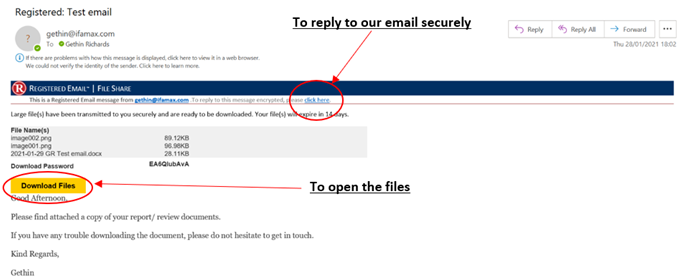
When we send an email encrypted it will appear in your inbox, like the test example below. Please note that these encrypted emails sometimes end up in junk/spam folders, so if you are expecting a document from us and have not received it please check your junk folder. You will be able to view the body of text from the sender and there will be notification of the file name sent.

 
newsletter1#.png
 

If you click to download the attachment we have sent, the following screen will appear for you to input the password shown in the original email. In this case EA6QIubAvA

You will also be able to reply to provide personal details using the same encrypted service (labelled in the picture above). When you reply it will look like the below. Just type your message and/or add any attachments and click ‘send encrypted’.

newsletter3.png

I hope this helps demonstrate how to use RMail and why we use it. We have had a number of our clients report that emails sent via RMail are sometimes received in their junk folder. We would recommend that you mark our emails as ‘not spam/ junk’ to prevent this regularly occurring. If you have any questions or problems using this encrypted service, please just get in touch and one of the team will be happy to help.

A final word of warning to stay vigilant, not just with what Ifamax is sending, but any email that lands in your inbox. In the last week alone we have heard of the following and I have attached print screens to show what a phishing scam can look like:

  • A Text message, requesting bank details that appear to be from the NHS in relation to the vaccine.

  • An email asking us to download a statement on SharePoint.

  • A Zoom meeting link, asking to click to ‘Review meeting’.

  • A notification to delete emails to make room for storage, from our own email address.

It is really important that you never click on a link in an email like the below examples.

Nothing contained in this article constitutes or should be construed to constitute investment, legal, tax or other advice. The information contained in this article shall in no way be construed to constitute a recommendation with respect to the purchase or sale of any investment.

Capital Gains Tax
tl-2.jpg

Capital Gains Tax (CGT) is paid by an individual when they have either sold or ‘disposed’ of an asset and made a gain on the original price they paid for it. The potential tax is only paid on the gain and not on the total sale value.

For example, if you bought some shares in Company X for £10,000, and then later sold these for £25,000, your total gain on which you would potentially pay capital gains tax would be £15,000.

 
Screenshot 2020-07-23 at 10.29.31.png
 

However, each individual is entitled to an annual capital gains tax allowance, of £12,300 for the 2020/21 tax year, on which all gains within this amount are free of tax. So, on our above example of £15,000 gain, only £2,700 of this would be taxed (£15,000 minus £12,300).

One important rule that is often overlooked and could potentially be a powerful tax planning tool, is that you do not normally pay Capital Gains Tax on assets you transfer to your husband, wife or civil partner. ​This can be really useful where one party has utilised their full allowance and the other has not, as you can potentially double your annual allowance.

​You can also use losses to reduce any gain. When you report a loss, the amount is deducted from the gains you made in the same tax year.​ If your total taxable gain is still above the tax-free allowance, you can deduct unused losses from previous tax years. If they reduce your gain to the tax-free allowance, you can carry forward the remaining losses to a future tax year.

Nothing contained in this article constitutes or should be construed to constitute investment, legal, tax or other advice. The information contained in this article shall in no way be construed to constitute a recommendation with respect to the purchase or sale of any investment.

The Benefits and Limits of Charitable Gifting
From Abermawr to Strumble.jpg

Limits

There are limits to the amount of gift aid that can be claimed by the charity and you could face a tax charge if the Gift Aid relief exceeds the UK tax you have paid during the tax year. You will need to have paid sufficient income or capital gains tax in the UK for a charity to claim the additional 25% of the donation. ​A simple rule to confirm your donations will qualify is to ensure they are not more than 4 times what you have paid in tax in that tax year (income or capital gains).​

Example: Dave will pay income tax of £2,500 for the 2020/21 tax year. He can, therefore, be comfortable that following a gift of £10,000 to Cancer Research UK the charity can claim full gift aid on his contribution. Anything over this gift amount can not be claimed as gift aid.

Benefits for higher and additional rate tax payers

​An additional benefit to individuals who pay tax at the higher and additional rate, is that you can claim further tax relief against your own income tax liabilities through your self assessment return. This is the difference between the respective rate of tax at 40% or 45% and the basic rate at 20%.

Nothing contained in this article constitutes or should be construed to constitute investment, legal, tax or other advice. The information contained in this article shall in no way be construed to constitute a recommendation with respect to the purchase or sale of any investment.

Charitable Gifting
tl.jpg

The ability to support  charity  is one that is extremely important for  many of our clients and indeed for people all around the UK. 

The  Charities Aid Foundation calculate that around £10 billion is gifted to  charity in the UK each year.​ With the events of 2020 and effects of Covid-19, the need for charitable  gifting is one that has been highlighted even more so, both with  individuals wanting to make donations, and also  the necessity for  donations for charities to survive and continue with their respective  works. 

Gift Aid​ 

The most popular, and often easiest, way to gift to charity in the UK is  through cash donations though the government’s Gift Aid scheme. Gift  Aid is a tax relief allowing UK charities to reclaim an extra 25% in tax on  every eligible donation made by a UK taxpayer.  ​Or put simply for every £1 you  donate , the charity can claim back an  extra 25p from the government.​ 

The basic premise for this is that as you are donating utilising money  you have already paid tax on the government agree to forward this tax paid (up to the basic rate of 20%) onto the charity. 

Nothing contained in this article constitutes or should be construed to constitute investment, legal, tax or other advice. The information contained in this article shall in no way be construed to constitute a recommendation with respect to the purchase or sale of any investment.

Cash Management
Aberaeron.jpg

In the current environment of historically low rates, efficient cash management can be an effective planning tool that is often overlooked.

Personal Savings Allowance

Savings interest is paid tax-free and most will not pay any tax on it at all. Basic-rate taxpayers can earn £1,000 per annum tax-free and higher-rate tax payers £500, so it is only those with much larger amounts of savings who would need to worry about this.

Financial Services Compensation Scheme (FSCS) protection​

As long as the bank institution you use is fully regulated in the UK, you get up to £85,000 of your money protected in the event of the bank going bust. It is important that you look to manage this effectively so you are not putting your cash at unnecessary risk.

Emergency Cash

We always recommend that individuals hold at least six months worth of expenditure in cash in an instant access account. This avoids being caught short in the event of a sudden need for cash; this could be for unforeseen expenditure or income shock.


Nothing contained in this article constitutes or should be construed to constitute investment, legal, tax or other advice. The information contained in this article shall in no way be construed to constitute a recommendation with respect to the purchase or sale of any investment.

Operating in a noisy environment

In most industrial settings, health-and-safety rules demand that appropriate protective gear be worn, including the donning of ear defenders in high decibel environments. Yet, when it comes to our investing health and safety, we have little by the way of regulatory guidance except the obligatory phrase ‘Past performance is no guide to future performance’ to protect ourselves from the noise of market outcomes, particularly when investing without the guidance of an advisor.

Investing in markets is a very noisy business and some form of ear defenders are required. Given that markets do a pretty good job incorporating information into prices, they tend to move randomly on the release of new information. Many investors are probably wondering today what returns will be like from equities in the final months of 2020 and perhaps next year too. Nobody knows (and do not believe anyone who claims to know). The chart below illustrates the monthly returns every year, from January 1970 to August 2020. As you can see, there is a lot of noise in the data.

Figure 1: Monthly returns of global developed market equities are very noisy

Data source: Morningstar Direct © All rights reserved (see endnote). MSCI World Index (gross) in GBP terms.

Data source: Morningstar Direct © All rights reserved (see endnote). MSCI World Index (gross) in GBP terms.

The only ear defenders that we have are behavioural. We must keep our true investment horizons – 20 to 30 years or more, in many cases - at the forefront of our minds, accept that investing is a two steps forward and one step back process and not look at our investment portfolios too frequently. The chart below shows that even on a yearly basis, returns from equities are noisy. The blue dots represent the calendar year returns and the red triangles represent the annualised return for the decade. Even the returns of decades are a bit noisy. Patience and fortitude are prerequisites for success.

Figure 2: Annual returns of global developed market equities are noisy too

Data source: Morningstar Direct © All rights reserved (see endnote). MSCI World Index (gross) in GBB terms.

Data source: Morningstar Direct © All rights reserved (see endnote). MSCI World Index (gross) in GBB terms.

Yet, over this period, global developed equity markets have delivered a return of 10.9% on an annualised basis before inflation and 6.5% after inflation (but before costs). Put another way, investors who stayed the course doubled their purchasing power every 12 years. With those sorts of longer-term returns, try not to let the noise of the markets keep you awake.

Risk warnings

This article is distributed for educational purposes and should not be considered investment advice or an offer of any security for sale. This article contains the opinions of the author but not necessarily the Firm and does not represent a recommendation of any particular security, strategy, or investment product.  Information contained herein has been obtained from sources believed to be reliable but is not guaranteed. 

Past performance is not indicative of future results and no representation is made that the stated results will be replicated.

Innovative and Lifetime ISA's
Boats and Ropes II.jpg

Whilst most are familiar with the relatively well-known cash or stocks and shares ISAs, the ‘newer ISAs on the block’; Innovative and Lifetime, may need a bit more of an introduction.

Innovative ISA

This allows you to invest in peer to peer (P2P) lending within an ISA wrapper. P2P is the process of lending your money to other individuals for a set period of time for a set rate of return. By removing the middle man of the bank, lenders can get better rates of return on their cash and borrowers can pay a lower rate of interest. ​In theory, the process should lead to a better outcome for both lenders and borrowers. However, they clearly come with their own risks in that the borrower may default and you could be left with nothing.

Lifetime ISA

The LISA was introduced in the 2017/18 tax year and designed to be used by either first-time house buyers or saved for later life income. ​You can put in up to £4,000 each year until you are 50 and can be opened from age 18-39. The government will add a 25% bonus to your savings, up to a maximum of £1,000 per year. ​You can withdraw funds from a LISA any time, but if you do this before the age of 60 and it does not relate to a qualifying house purchase, you could be hit with a penalty.

​Broadly speaking, for the majority of people saving, a LISA is most efficient for first-time house buyers, so this could be an option for yourself or those seeking to help children/grandchildren onto the property ladder.

Nothing contained in this article constitutes or should be construed to constitute investment, legal, tax or other advice. The information contained in this article shall in no way be construed to constitute a recommendation with respect to the purchase or sale of any investment.

Insignis Cash Management

All asset classes are important to us, and cash is just one of them. To enhance our service model, Ifamax has partnered with Insignis. ​Insignis Cash Solutions is an innovative cash management solution that complements your asset portfolio by looking after your cash.

​Cash is different to your other assets due to its liquidity and return potential. This service allows you to get a better return than you would at a traditional high street bank, while still allowing you to determine what liquidity requirements suit you. ​The great benefit of using this service is that it is done with a single sign in procedure, making it as easy for you as possible. ​Insignis use a number of secure UK-based financial banks to invest your cash.

All the banks used have FSCS protection, which is currently £85,000 per bank, per individual. This gives our clients a variety of options, depending on the capital amount and term requirements. ​The service is aimed towards those that typically hold high cash balances as the minimum account size is £50,000.

How could you benefit:​

-Client remains the beneficial owner at all times​

-A single sign-up procedure, giving you access to multiple bank accounts​

-Interest rate monitoring and cash account management​

-The ability for Ifamax to manage the service on your behalf (if required)​

-View your live cash portfolio online​

-Their assets being safe and secure ​

-Individuals, Companies, Trusts or Charities​​

Nothing contained in this article constitutes or should be construed to constitute investment, legal, tax or other advice. The information contained in this article shall in no way be construed to constitute a recommendation with respect to the purchase or sale of any investment.

Good things come to those who wait.

Good things come to those who wait. This was the strapline once used by Guinness to refer to the 119.5 seconds it takes to pour a ‘perfect’ pint of their iconic stout. In investing, the time periods we are concerned about are measured in years, rather than seconds. Looking at your investment portfolio too often only increases the chance that you will be disappointed. This of course can be challenging at times, particularly during tumultuous markets.

We can see from the figure below that monitoring markets on a monthly basis looks rather stressful, as they yoyo through time. Green areas represent times during which the market is growing its purchasing power (i.e. beating inflation) and red areas when it is contracting.

Figure 1: Monthly real growth/contraction of global equities, Jan-88 to Jun-20

Data source: MorningstDar Direct © All rights reserved. MSCI World (net div.) net of UK CPI, before charges. Dividends reinvested.

Data source: MorningstDar Direct © All rights reserved. MSCI World (net div.) net of UK CPI, before charges. Dividends reinvested.

The evident month-on-month noise captured by the figure above is a consequence of new information being factored into prices on an ongoing basis. Investors around the world digest this information, decide whether it will cause a change in a company’s cashflows (or the risks to them occurring), and hold or trade the stock accordingly. These are the concerns of active investors casting judgements on individual stocks’ prospects.

Over longer holding periods, the day-to-day worries of more actively managed portfolios are erased, as equity markets generate wealth over the longer term. The figure below illustrates that monthly rolling 20-year holding periods has never resulted in a destruction of purchasing power. A longer-term view to investing enables individuals to spend more time focusing on what matters most to them and to avoid the anxiety of watching one’s portfolio movements.

Figure 2: Monthly rolling 20-year real growth/contraction of global equities, Jan-88 to Jun-20

Data source: Morningstar Direct © All rights reserved. MSCI World (net div.) net of UK CPI, before charges. Dividends reinvested.

Data source: Morningstar Direct © All rights reserved. MSCI World (net div.) net of UK CPI, before charges. Dividends reinvested.

This is not to say that investing is a set-and-forget process, however. The Investment Committee meets regularly on your behalf to kick the tyres of the portfolio, after reviewing any new evidence. Over time there may be incremental changes to your investments (there may not!) as a result, but the Committee shares the outlook illustrated in the figure above – we have structured your portfolio for the long term, and it is built to weather all storms.

Delving deeper

The figure below provides longer term market data in the US back to 1927. The result is the same. The cherry-picked 20-year example provided towards the bottom of the figure shows a time fresh in many investors’ minds: the bottom of the Credit Crisis. In this (extreme) 20-year period, to Feb-09, equity markets had barely recovered from the crash of technology stocks in the early 00s, before falling over 50% in 2008/9, in real terms. These were scary times.

Despite the headwinds, investors had been rewarded substantially for participating in the growth of capital markets over the longer term. An equity investor viewing their portfolio for the first time in 20 years would have seen their wealth more than double, whilst at the same time the media was reporting headlines such as ‘Worst Crisis Since ‘30s, with No End Yet in Sight’(1)

Have faith in wealth-creation through capitalism and try not to look at your portfolio too often. As the adage goes: ‘look at your cash daily if you need to, your bonds once per year, and stocks every ten’.

(1) Wall Street Journal, September 18, 2008

Figure 3: Long term US stock market growth in purchasing power

Data source: Morningstar Direct © IA SBBI US Large Stock Infl Adj TR Ext in USD. Market events: https://eu.usatoday.com/

Data source: Morningstar Direct © IA SBBI US Large Stock Infl Adj TR Ext in USD. Market events: https://eu.usatoday.com/

ISA Planning
From Abermawr to Strumble.jpg

The ISA allowance is something that can strangely be both under and over appreciated by people, dependent on their perception of it. Understanding the rules and advantages of the various ISAs available inline with your own personal situation is something that can be a powerful planning tool.​ The ISA allowance for the 2020/21 tax year has remained the same as last year at £20,000 and this can be spread across each of the four types of ISA available to you.

The four types of ISAs are:

 
Screenshot 2020-07-23 at 09.47.37.png
 

The basic premise of any ISA is that you do not pay tax on ​ interest on cash in an ISA ​ income or capital gains from investments in an ISA. ​This can be especially useful for those who have large investment or cash holdings outside of any tax-advantaged wrappers. By ‘sheltering’ as many of these assets as possible in ISAs, you are potentially reducing ongoing tax bills.​ However, with the respective allowances we all have for both interest and dividend income and capital gains, striving to get everything into ISA where possible isn’t always required.

Nothing contained in this article constitutes or should be construed to constitute investment, legal, tax or other advice. The information contained in this article shall in no way be construed to constitute a recommendation with respect to the purchase or sale of any investment.


Junior ISA's
Newport Parrog.jpg

Junior ISAs are long term tax free savings accounts for children. In order to open a JISA, a child must be under the age of 18 and be living in the UK. The current limit for JISAs is £9,000 a year. Like the standard adult ISA, children can have either a cash or stocks and shares JISA. ​Parents or guardians can open and manage a JISA on behalf of a child, however, the money belongs to the child. It is important to remember that whilst children can take control of their own JISA at age 16, they will not be able to access any of the proceeds until they are at least 18. Equally important to remember, is that children are entitled to their JISAs at 18 and can do as they wish with the funds.

Whilst some providers may offer what look like attractive interest rates on cash JISAs, you must be careful to remember that if the child has a number of years before they can access the fund, it may be better off being invested into stocks and shares. Given time, this would be expected to give returns beyond any cash JISAs.​ Anyone can add money to a JISA for a child, so parents and grandparents could see this as a good opportunity to build savings for a child in a protected ‘environment’.

Nothing contained in this article constitutes or should be construed to constitute investment, legal, tax or other advice. The information contained in this article shall in no way be construed to constitute a recommendation with respect to the purchase or sale of any investment.

Commercial property in a post-Covid world

One of the most common questions that is currently asked by clients is what the prospects are for commercial property in the future. We have all by now – in our new normal world - got used to meeting our dearest friends, family, and work colleagues on Zoom or Skype, working from home, and shopping online.  High streets and shopping malls were struggling even before the events of 2020 with Debenhams and several middle-market food chains in trouble.

That has led some investors to beg the question as to what the future holds for commercial property. Will everyone work from home? Will companies reduce their office space needs, providing workers with a hot desk each morning, if they are in? Will retail companies go into administration to put pressure on landlords to reduce rents?  Will more people shop online? The answer to all of these questions is probably ‘yes’. Does that mean that we should abandon a well-diversified, liquid exposure to global commercial property accessed via real estate investment trusts (REITs), which are listed property companies, focused almost exclusively on generating rental income? We think not.

First, let us look at the flipside of the changes that are occurring. To be sure, some sectors may struggle.  But for every Debenhams, there will be a company moving into, or even starting up, online, which will require logistics centers and warehousing. In our digital age, there is increasing demand for secure and up-to-date data centers, improved and more numerous healthcare facilities for example. You can see from the chart below that the global commercial property REITs cover many things.

pic1.jpg

In a globally diversified REIT index fund, there are over 350 individual REITs (listed property companies) each of which is comparable to a property fund in its own right. It is estimated that such a fund contains around 90,000 properties[1] spread across property types, global markets, and strategies.

Second, let us spend a moment thinking about markets. These worries about the retail sector, for example, have been around for some time and you will not be the only person thinking about these issues. In fact, thousands - or even millions – of people will already have done so and acted on their view of the future of property, by buying and selling these REITs in the market. The aggregate view will be reflected in today’s REIT prices: all the doom, gloom and uncertainty is priced into the process of REITs already;  all the likelihood that the way we work changes is priced in already; and all the good news about data centers and warehousing is priced in already. So, the future prospects for commercial property will depend on what happens relative to this expectation.  It may be better or worse, depending on information we do not yet know. The release of that information is random. What we do know is that commercial property will continue to be needed and that companies will have to pay rent. We would not abandon owning a diversified equity portfolio because some sectors are struggling (airlines and energy) or concentrate our portfolio in sectors that are booming (technology). It is already in the price. Companies and sectors wax and wane.

Third, let us think about why we hold it in portfolios in the first place. Property tends to have a different return experience to equities (even though property companies are listed on stock markets). At specific times, and across time, this can provide diversification to a portfolio. In addition, over time property has provided protection from inflation; after all, a property is a property and many rental agreements are linked to some measure of inflation. With the rapid increase in the money supply, on account of all the government support packages around the world, higher inflation - not something most feel the need to worry about currently – is one future scenario. Cover the bases - but all things in moderation - is a sensible approach. An allocation to global commercial property still makes sense for long-term investors, as part of their diversified growth assets.

[1] Source: Prologis is the largest REIT at 5% of the index and owns ~4,500 properties.  Scaling this up implies around 90,000 properties across the index, as a rough proxy.

Risk warnings

This article is distributed for educational purposes and should not be considered investment advice or an offer of any security for sale. This article contains the opinions of the author but not necessarily the Firm and does not represent a recommendation of any particular security, strategy, or investment product.  Information contained herein has been obtained from sources believed to be reliable but is not guaranteed. 

Past performance is not indicative of future results and no representation is made that the stated results will be replicated.