
Case Study: Building a £500,000 Crypto Diversification Plan

Over the last five articles in this series, we have explored:
Turning crypto gains into long-term wealth
The psychology of holding crypto
Tax planning considerations
Retirement planning
The importance of diversification
In this final article, we bring everything together with a practical example.
Imagine an investor who started with a relatively modest crypto allocation and, through strong market growth, now holds around £500,000 of crypto wealth.
The question is no longer:
"Should I buy Bitcoin?"
The question becomes:
"How do I protect what I have built while still participating in future growth?"
This is where diversification and financial planning become increasingly important.
How a £10,000 Bitcoin Investment Has Grown
The chart below shows how a £10,000 investment in Bitcoin has performed since 2020.

The chart highlights two important realities:
First, the long-term returns have been extraordinary.
Second, the journey has been far from smooth.
Investors have experienced significant rises and falls along the way. For many people, these fluctuations can be emotionally challenging, particularly when crypto accounts for a substantial share of their overall wealth.
Timing also matters. Entering the market shortly before a major correction can produce a very different experience from investing during a downturn.
This is one reason why many investors eventually begin asking whether some of their crypto wealth should be diversified into other assets.
Why Diversification Matters
Bitcoin remains a highly volatile asset.
While volatility has reduced from the extreme levels seen in its early years, it remains significantly higher than most traditional investments.
For investors who have accumulated substantial crypto wealth, diversification can potentially:
Reduce portfolio volatility
Improve long-term resilience
Create future retirement income opportunities
Support tax-efficient planning
Reduce dependence on a single asset class
At Ifamax Wealth Management, our investment approach combines a range of complementary assets, including:
Equities (shares in companies)
Fixed income (government and corporate bonds)
Property investments
Cash and other diversifying assets, where appropriate
The objective is not to eliminate risk.
The objective is to create a portfolio capable of supporting long-term financial goals while managing uncertainty.
Understanding Diversification Through Correlation
One of the key concepts behind diversification is correlation.
Correlation measures how closely different assets move together.
A correlation of 1.0 means assets move in lockstep.
A correlation of 0 means movements are largely unrelated.
A negative correlation means assets may move in opposite directions.
The table below illustrates a typical long-term correlation matrix for Bitcoin and other major asset classes.

Several observations stand out.
Government Bonds
Government bonds remain one of the strongest traditional diversifiers.
As shown in Table 1, they have historically displayed a low or slightly negative relationship with equities. This can help cushion portfolio declines during periods of market stress.
Corporate Bonds
Corporate bonds typically sit between equities and government bonds.
They can provide income and stability but remain partially influenced by stock market sentiment and economic conditions.
Property
Property often feels different to equities, but listed property investments frequently move alongside stock markets.
As shown in the table, property can provide diversification benefits, but it is not completely independent from equity market movements.
Bitcoin
Bitcoin displays lower long-term correlations than many traditional assets.
This is one reason some investors view Bitcoin as a diversifier within a broader portfolio.
However, correlation is not static.
During periods of market stress, asset relationships can change dramatically.
Historically, Bitcoin's correlation with equities has risen significantly during market downturns, reducing its diversification benefits precisely when investors need them most.
This is why diversification should never rely solely on historic correlations.
A Practical Diversification Example
To demonstrate how diversification can work in practice, we created a hypothetical portfolio incorporating Bitcoin alongside traditional investments.
The assumptions are illustrative and should not be considered investment advice.
For this example, we assumed:
A £10,000 starting investment
Bitcoin returns of 25% per annum
A diversified mix of equities, bonds and property
Long-term correlation assumptions shown earlier
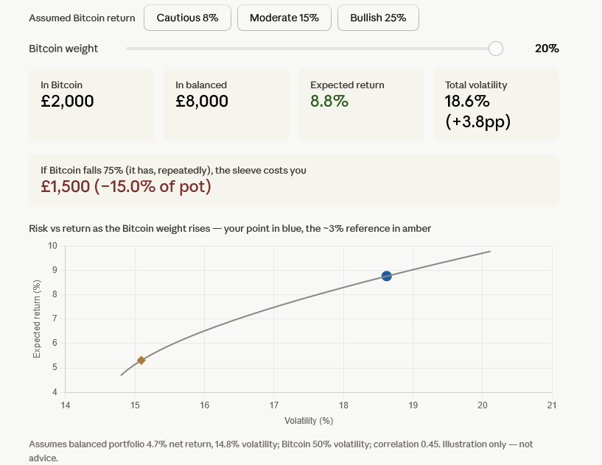
The results are interesting.
Adding a measured allocation to Bitcoin increases the portfolio's expected return potential.
However, it also increases overall volatility.
The benefit of diversification is that volatility is significantly lower than holding Bitcoin alone.
In other words, investors may still participate in future growth opportunities without having all their wealth tied to a single asset.
What Happens If Bitcoin Falls?
Risk remains important to understand.
Even within a diversified portfolio, significant market declines can still occur.
For example:
If Bitcoin represented 20% of a portfolio and fell by 75%, the overall portfolio impact would still be approximately 15%.
While uncomfortable, this is materially different from experiencing a 75% decline across an entire portfolio.
This illustrates one of the central principles of wealth management:
Diversification does not eliminate risk.
It helps ensure that one investment does not determine your financial future.
From Crypto Success to Financial Freedom
Throughout this series, we have followed a common journey.
Many investors begin with a small crypto allocation.
Over time, strong performance can transform that allocation into a significant proportion of overall wealth.
Eventually, the conversation changes.
The focus moves away from accumulation and towards:
Preserving wealth
Generating future income
Retirement planning
Tax-efficient strategies
Intergenerational wealth planning
Reducing concentration risk
For some investors, that may involve retaining a meaningful crypto allocation.
For others, it may involve gradually diversifying into a broader portfolio of assets.
The right solution depends on individual objectives, risk tolerance and financial circumstances.
Final Thoughts
Across this six-part series, we have explored the opportunities and challenges associated with crypto wealth.
The common theme has remained consistent.
Crypto may help create wealth.
Financial planning helps protect it.
At Ifamax Wealth Management, we work with investors who want to turn investment success into long-term financial security through thoughtful financial planning, retirement planning and wealth management.
Whether your goal is to grow, protect or pass on wealth, diversification remains one of the most powerful tools available.
Related Links
FOMO, Fear, and “Just One More Pump”: The Mind Games of Crypto
Crypto Diversification: Why Stocks, Bonds and Property Still Matter
Important note
This article is distributed for educational purposes only and should not be considered investment advice or an offer of any security for sale. This article contains the opinions of the author but not necessarily the Firm and does not represent a recommendation of any particular security, strategy, or investment product. Reference to specific products is made only to help make educational points and does not constitute any form or recommendation or advice. Information contained herein has been obtained from sources believed to be reliable but is not guaranteed.
Article Written: June 2026, Tax Rates and Allowances May Change In The Future.