
FOMO, Fear, and “Just One More Pump”: The Mind Games of Crypto

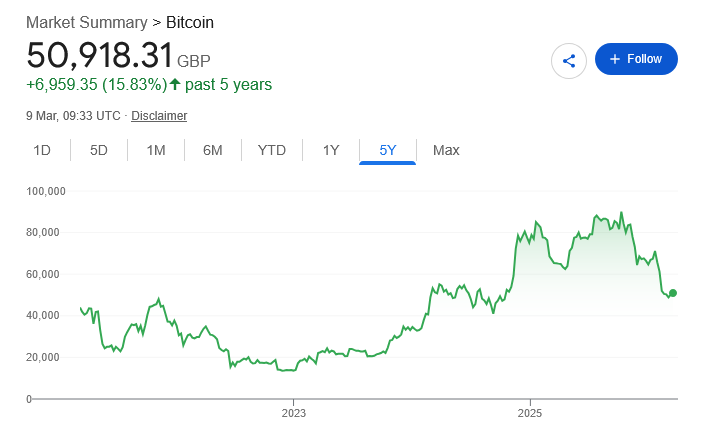
If you purchased Bitcoin in May 2016, the return to 3 March would be 16,189.17%. In simple terms, £10,000 would now be worth just over £1.6 million.
For many early investors, this wasn’t a carefully modelled plan. It was more like stepping into uncharted territory, a pioneer move, with no real certainty about how it would play out.
If that’s you, there’s a good chance crypto has become a meaningful part of your wealth. At that point, the question often isn’t “Should I sell everything?” It’s usually more practical than that:
How do I spread the risk without losing the upside entirely?
Because the reality is this: Bitcoin is still a volatile asset. In the early days, volatility was eye-watering. It has eased from those extremes, but it remains high enough that deciding when to trim, sell, or reallocate can feel almost impossible, especially when prices are back at levels last seen a couple of years ago.
And for pioneers, there’s a second reality that’s harder to say out loud:
The life-changing returns often come from taking extreme risk… and holding through moments that felt genuinely uncomfortable.
That’s why strategy matters. Not a perfect prediction. A strategy you can stick to.
Why crypto timing feels uniquely brutal
Crypto doesn’t have an off-switch.
Markets trade 24/7, and the news cycle runs at full speed too: price alerts, headlines, social posts, influencers, group chats. It’s easy to get pulled into the narrative and, without noticing, into our behavioural biases: hearing what we want to hear, avoiding what makes us uneasy, chasing reassurance.
The timing problem is simple:
Over long periods, returns can look extraordinary.
Over short periods, outcomes can be wildly different depending on when you bought (and when you needed the money).
With an asset that can fall sharply in a matter of days, you can “lose” a large chunk of value on paper, and then find yourself waiting, hoping, and second-guessing every decision.
That’s not a character flaw. It’s what this type of market environment is designed to do to a human brain.
The six psychological traps that hijack crypto decisions
1) FOMO (fear of missing out)
When an asset moves fast, the temptation is to hold “just a bit longer”, because what if the next surge is the surge?
The danger is that you end up taking more risk than you intended, simply because the market is noisy.
2) Loss aversion
Losses hurt more than gains feel good. That can lead to two common patterns:
holding a falling asset because selling would make the pain “real”
delaying sensible decisions because you’re waiting to “get back to even”
3) Recency bias
If it’s been going up, it feels like it will keep going up.
If it’s been falling, it feels like it will keep falling.
Crypto amplifies this because the moves are dramatic and constant.
4) Confirmation bias
When there’s a lot of noise, we naturally select the noise that supports our view.
One feed tells you “Bitcoin is going to £X.” Another tells you it’s going to zero. It’s easy to curate your inputs without realising it.
5) Overconfidence
Sometimes people confuse outcome with skill. Early success can create a belief that you can outmanoeuvre the crowd.
But many big “wins” are a blend of conviction, timing, and luck, and it’s wise to treat them that way.
6) Herd behaviour
In a bull market, everyone looks clever. In a downturn, everyone suddenly becomes a risk expert.
Often, the hardest (and best) decisions are made when the crowd is doing the opposite.
The “casino design” features that make timing worse
One practical question we ask clients at Ifamax is:
“If this went wrong, how much are you genuinely prepared to lose?”
If someone says, “10% of what I’m investing in this idea,” that can be a useful anchor. It helps separate:
long-term planning money (for retirement, family, security), from
higher-risk “speculation money” (where loss is survivable)
Crypto isn’t identical to gambling, but it can behave like it in the way it pulls on emotion, especially when the environment is built around constant stimulation.
The goal is not to moralise. It’s simply to keep the core plan protected.
A practical alternative to “perfect timing”
When we’ve helped clients manage crypto exposure sensibly, it usually follows a calm, repeatable pattern:
Define the role of crypto in your overall plan
Is this a speculative satellite holding?
Or do you see it as a long-term allocation?
Be honest here. Your plan depends on it.
Set pre-commit rules (before emotion hits)
Maximum allocation as a % of investable assets
Rebalancing bands (when you trim/add)
What would make you reduce exposure?
What does “enough” look like?
Use staged decisions, not all-in/all-out moves
Phasing can reduce regret. It’s rarely perfect, but it’s often more livable.
Match decisions to your time horizon
Needing money in 12 months is very different to investing for 5–10 years.
A simple decision checklist you can steal
Before you do anything, ask:
If this dropped 40% tomorrow, would I still be OK?
Am I acting because of a plan, or because of a chart?
What’s my exit plan, both profit-taking and loss limits?
What % of my net worth does this represent?
Who benefits if I take this trade, the exchange, the influencer, or me?
If those questions feel uncomfortable, that’s usually a signal to slow down.
What good looks like (especially for early pioneers)
If you were early and crypto gains now represent something meaningful, perhaps you want liquidity, income planning, or you’re thinking about retirement, this is where advice can add real value.
At Ifamax Wealth Management, we understand the emotional side of these decisions as well as the technical side. And we’re not trying to “call the top.” We focus on process over prediction.
We can move as fast or as slow as you want. It might sound boring, but boring is often what protects wealth.
If you’d like to talk it through, speak to a Financial Planner at Ifamax in Bristol.
What’s next in the series
In the next blog, we’ll look at how crypto could potentially support retirement planning, and how to make that practical without letting volatility run your life.
Frequently Asked Questions
Why is crypto so emotionally addictive?
Because it combines fast price movement, 24/7 access, constant news, and social proof, all of which amplify behavioural biases.
How much crypto is “reasonable” in a diversified plan?
There’s no universal number. It depends on objectives, time horizon, capacity for loss, and what else you own.
Why do most people struggle with crypto trading?
Because the environment rewards activity, emotion, and confidence, while long-term outcomes usually reward patience, risk control, and discipline.
Important note
This article is distributed for educational purposes only and should not be considered investment advice or an offer of any security for sale. This article contains the opinions of the author but not necessarily the Firm and does not represent a recommendation of any particular security, strategy, or investment product. Reference to specific products is made only to help make educational points and does not constitute any form or recommendation or advice. Information contained herein has been obtained from sources believed to be reliable but is not guaranteed.