
How to Build a Tax-Efficient Portfolio in 2026
Artificial intelligence can do some impressive things.
Ask it how much you can invest in an ISA, and it can tell you.
Ask about pension tax relief, Capital Gains Tax allowances or the rules around a Lifetime ISA, and it can produce an answer within seconds.
For some people with relatively straightforward finances, this access to information may make it easier to manage more of their financial planning themselves.
But there is an assumption hidden within that.
That we know which questions to ask.
We also must keep up with changing legislation, understand how those changes affect us personally and then make decisions objectively.
That is where the difference between knowing the tax rules and having a financial plan becomes important.
Tax rules do not stand still
The Lifetime ISA is a good example.
It was introduced in April 2017 as a way for younger people to save towards either their first home or later life. Someone aged 18 to 39 can currently open one, contribute up to £4,000 each tax year and receive a 25% government bonus. Contributions can continue until age 50. The money can normally be accessed without the withdrawal charge to buy a qualifying first home, from age 60, or in certain cases of terminal illness.
It was sometimes viewed principally as another first-time-buyer product.
But it was always more interesting than that because it combined two potential outcomes:
buying a home or saving for later life.
The challenge is that the world around a financial product can change while some of its rules remain the same.
To use a Lifetime ISA towards a first home, the property must currently cost £450,000 or less. A withdrawal for a property above that limit would not qualify and would normally face the 25% withdrawal charge.
When the Lifetime ISA arrived in 2017, the average property price in England was around £238,000. By May 2026, it was £292,000.
Closer to home, the average property price in Bristol was £355,000 in May 2026. The average semi-detached home was £450,000, exactly the current Lifetime ISA property limit.
A product that looked straightforward when somebody started saving at 20 may therefore look rather different when they are ready to buy at 30.
And the rules are changing again.
The Government launched a consultation in June 2026 on a new First Time Buyer ISA, intended eventually to replace the Lifetime ISA. The detailed design is still under consideration, so this is an area to watch rather than one on which to base a plan today.
This is the important point.
Financial planning cannot simply be about choosing a product once and forgetting about it.
Start with the outcome, not the tax wrapper
When people talk about building a tax-efficient portfolio, it is tempting to start with a list.
ISA.
Pension.
VCT.
Investment bond.
Capital Gains Tax allowance.
But that is starting at the wrong end.
Before deciding where the money should go, we need to understand what it needs to do.
Are you saving for a house in five years?
Building financial independence?
Planning to retire at 60?
Looking for income during retirement?
Saving for children?
Trying to pass wealth to the next generation?
Or perhaps several of these at the same time?
The right tax wrapper for money you may need in three years could be completely different from the right wrapper for money you do not expect to touch for 30 years.
Tax-efficient financial planning starts with the outcome and then builds the strategy around it.
For many people, two of the most important building blocks will still be ISAs and pensions.
But they do very different jobs.
ISAs: simple, flexible and valuable
Not everybody can invest the maximum ISA allowance each year.
That does not make an ISA any less valuable.
For the 2026/27 tax year, an individual can subscribe up to £20,000 across their ISAs. Interest, investment income and capital gains generated within an ISA are not subject to UK tax.
For a standard ISA, another significant advantage is accessibility.
Money can generally be withdrawn whenever you want, although individual providers or products may have their own terms or charges. Lifetime ISAs have different withdrawal rules.
That flexibility can become particularly valuable in retirement.
A pension withdrawal may create taxable income.
An ISA withdrawal normally does not.
Having both can therefore provide more choices over where retirement spending comes from.
But there is a cost to waiting
ISA allowances work annually.
If you have the capacity to invest £20,000 this year but only invest £10,000, you cannot simply add the unused £10,000 to next year's ISA subscription limit.
That opportunity has gone.
Contrast that with pensions, where unused annual allowance can sometimes be carried forward from the previous three tax years, subject to the rules and the individual's circumstances.
This is why tax planning is not always about doing something complicated.
Sometimes it is simply about using the allowances available to you consistently over many years.
ISAs are changing from April 2027
There is another good example of why plans need reviewing.
From 6 April 2027, the overall ISA subscription limit will remain £20,000, but people under 65 will normally be limited to £12,000 of subscriptions to Cash ISAs. Those aged 65 and over will retain a £20,000 Cash ISA limit. The Stocks and Shares ISA limit remains £20,000, within the overall ISA allowance.
There are additional anti-circumvention rules planned. These include restrictions on transfers from non-cash ISAs into Cash ISAs for those under 65, a 22% charge on interest generated by cash held inside non-cash ISAs, and rules preventing a non-cash ISA being composed entirely of money market funds.
For somebody who has traditionally used their Stocks and Shares ISA to hold large cash balances while deciding when to invest, that potentially changes the planning.
Again, the product has not suddenly become “good” or “bad”.
The rules have changed.
The plan may therefore need to change with them.
Pensions: still one of the foundations of retirement planning
Pensions remain another important building block.
Most employees will already be contributing to a workplace pension, and eligible employees benefit not only from their own contributions but also from their employer's contributions. Under the standard automatic-enrolment minimum, the employer currently pays at least 3%, with total minimum contributions of 8% on qualifying earnings, although many schemes are more generous.
There is an obvious attraction.
Pension contributions can attract tax relief.
For most people, the standard pension annual allowance is currently £60,000, although the amount that can be contributed with tax advantages depends on earnings and individual circumstances, and reduced allowances can apply to higher earners or to people who have flexibly accessed pensions.
At retirement, you can usually take up to 25% of your pension as tax-free cash, subject to the standard £268,275 lump sum allowance unless you hold a protected allowance. Other pension withdrawals will normally be subject to Income Tax.
That makes pensions potentially very tax-efficient.
But there is a trade-off.
You give up access
Unlike an ISA, you cannot normally access pension savings whenever you want.
The normal minimum pension age is currently 55 and is scheduled to rise to 57 from 6 April 2028, subject to limited exceptions and protected pension ages.
So, imagine somebody aged 40 wants to retire at 55.
Putting everything into pensions because they provide attractive tax relief could create an obvious problem.
They may have considerable wealth but be unable to access enough of it when they actually want to stop working.
An ISA and other investments may therefore need to provide the bridge.
This is why the question is not:
“Is a pension better than an ISA?”
It is:
“What combination gives me the flexibility to achieve what I want?”
Pension planning is also changing in 2027
There is another major change approaching.
From 6 April 2027, most unused pension funds and pension death benefits will be brought within an individual's estate for Inheritance Tax purposes. The change was legislated through Finance Act 2026.
That does not mean pensions suddenly become unattractive.
They remain primarily retirement vehicles and retain significant tax advantages.
But it does mean that for some families the role pensions play within estate planning will change.
It also creates some very practical questions.
Do your family know what pensions you have?
Are your beneficiary nominations up to date?
Does the pension scheme offer the death-benefit flexibility you expect, such as beneficiary drawdown?
Do your executors have sufficient information to identify all your pension arrangements?
And does your retirement strategy still make sense once pensions are considered alongside the rest of the estate?
The Income Tax position on inherited pensions also needs to be distinguished from Inheritance Tax. Broadly, where someone dies before age 75, certain beneficiary drawdown and lump-sum benefits can still be paid free of Income Tax if the relevant conditions are met. Where death occurs at 75 or over, beneficiary withdrawals are generally taxable. The new 2027 rules add potential Inheritance Tax into that picture rather than simply replacing the existing Income Tax rules.
That distinction is exactly the sort of thing that can be lost if we simply ask:
“Are pensions tax-efficient?”
The correct answer is:
It depends what you are trying to achieve.
What happens when ISAs and pensions are already being used?
For people with greater investable wealth, tax planning may move beyond these two core wrappers.
That does not necessarily mean immediately looking for increasingly complicated products.
A General Investment Account can still have a role.
The difference is that tax needs to be managed.
For 2026/27, the individual Capital Gains Tax annual exempt amount is £3,000.
This can create opportunities for ongoing planning.
Bed and ISA
Someone holding investments outside an ISA may sell investments from their General Investment Account and use the proceeds to subscribe to an ISA, assuming they have sufficient ISA allowance available.
This is commonly called Bed and ISA.
The sale itself is a disposal for Capital Gains Tax purposes, so any gain needs to be considered before the transaction takes place.
Over time, however, this can gradually move investments from a taxable environment into a tax-efficient one.
Use Capital Gains Tax allowances
Rather than waiting until a large portfolio is eventually sold and potentially creating a substantial taxable gain, it may be appropriate to realise gains gradually.
The annual exempt amount is currently only £3,000, but using it over a number of years can still form part of sensible portfolio management.
Do not forget losses
Investment losses are not pleasant, but they can have tax value.
Allowable capital losses can generally be offset against gains, and unused reported losses may potentially be carried forward to later years.
Good tax planning therefore looks at the portfolio as a whole rather than simply focusing on the investments that have made money.
Think about ownership between spouses
Assets can generally be transferred between spouses or civil partners who are living together on a no gain/no loss basis for Capital Gains Tax purposes.
Because spouses and civil partners are taxed separately, considering who owns taxable investments can sometimes allow allowances and tax bands to be used more effectively.
This is not about moving assets purely for the sake of moving them.
Ownership needs to make sense within the wider financial and estate plan.
What about VCTs and investment bonds?
Once pensions and ISAs have been considered, more specialist tax planning may have a role.
But this is where I think an important principle applies:
Do not allow the tax relief to make the investment decision for you.
Venture Capital Trusts
Venture Capital Trusts can provide tax advantages, but they invest in smaller, higher-risk businesses and should not be viewed simply as another pension or ISA.
From 6 April 2026, the upfront Income Tax relief available on qualifying new VCT investments was reduced from 30% to 20%.
That reduces one of the headline incentives.
It does not automatically make VCTs unsuitable, but it makes it even more important that the underlying investment and risk make sense before considering the tax benefits.
Onshore and offshore investment bonds
Investment bonds may also play a role in more sophisticated planning, particularly once more straightforward allowances have been considered.
One feature is the ability to make partial withdrawals of broadly up to 5% of accumulated premiums without an immediate chargeable-event gain. Importantly, HMRC describes this as tax deferral, not a tax exemption. The eventual tax position depends on what happens later and the individual's circumstances.
That distinction matters.
“Tax deferred” and “tax free” are not the same thing.
Again, the product is simply a tool.
Whether it is useful depends on the job you need it to do.
Different goals produce different portfolios
Consider three people.
Someone saving for their first home
A younger person may want to build a deposit while retaining sufficient emergency savings.
A Lifetime ISA might currently be part of that strategy because of the 25% government bonus, but they also need to think about when they plan to buy, likely property prices and the £450,000 qualifying-property limit.
And with a proposed First Time Buyer ISA now under consultation, the rules themselves may evolve before they buy.
Someone building towards retirement
Someone in their 40s or 50s may place greater emphasis on pensions and Stocks and Shares ISAs.
Pension contributions may provide valuable tax relief.
ISAs provide flexibility.
Together, they can potentially allow retirement income to be drawn from different places in different tax years.
The aim is not to maximise one particular product.
It is to create options.
A higher earner or business owner
For somebody with significant surplus income, bonuses or business profits, planning may be more complicated.
Pensions, ISAs, spouse allowances, General Investment Accounts and potentially more specialist structures may all need to be considered.
The order in which they are used can matter.
The tax position can matter.
But so can accessibility, investment risk, retirement timing, family objectives and estate planning.
This is where financial planning starts to move well beyond answering:
“Where should I invest this year's money?”
So, can AI build your financial plan?
Perhaps for some people.
AI can already make financial information far easier to access.
It can explain an ISA.
It can calculate pension contributions.
It can summarise tax changes.
It can compare products.
And those capabilities will almost certainly continue to improve.
But accessing information is not quite the same thing as financial planning.
Good planning requires somebody to understand what they are trying to achieve, identify the compromises, decide what matters most and keep reviewing the plan when circumstances or legislation change.
It also requires objectivity.
When markets fall, will you follow the strategy?
When a new product appears offering attractive tax relief, will you understand whether you actually need it?
When the Government changes pension or ISA rules, will you know which parts of your plan need changing?
And perhaps most importantly:
Will you know which questions you should be asking?
Tax efficiency is not the destination
A tax-efficient portfolio should not be constructed by collecting as many tax-efficient products as possible.
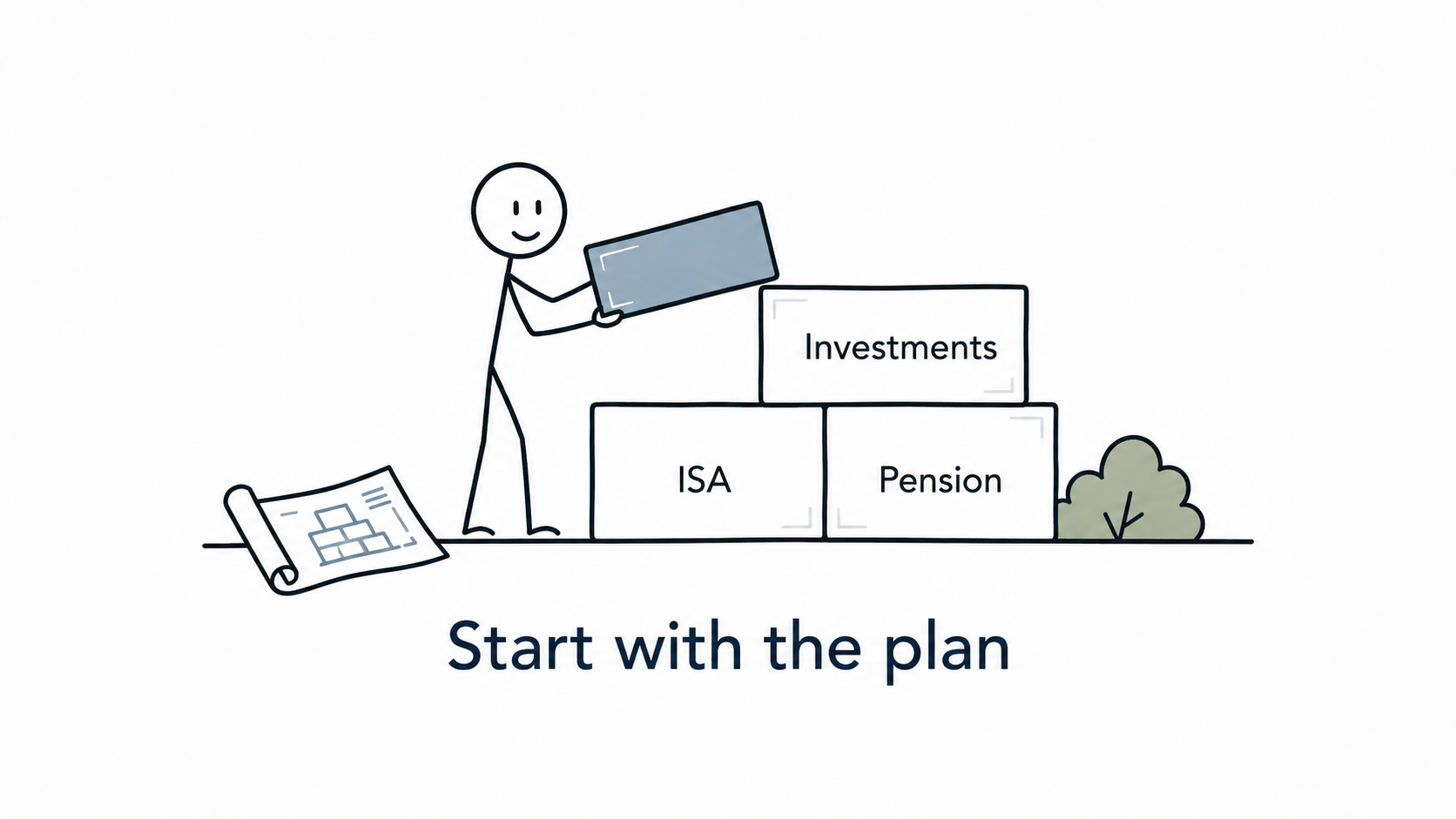
Start with the plan.
Understand when you need the money.
Understand what you are trying to achieve.
Keep enough flexibility for life not to happen exactly as expected.
Then consider which combination of pensions, ISAs, investments and other planning strategies can help you get there.
Tax efficiency matters.
But paying the least tax possible is not necessarily the same as achieving the best financial outcome.
The objective is to build wealth, protect it and ultimately use it for the life you want.
Tax planning should help you do that.
It should not become the plan itself.
Frequently asked questions
What is a tax-efficient portfolio?
A tax-efficient portfolio structures savings and investments so that available tax allowances and wrappers are used appropriately while still meeting the investor's wider objectives. It might include pensions, ISAs and taxable investments rather than relying on one product.
How much can I invest in an ISA in 2026?
The overall ISA subscription allowance is £20,000 for the 2026/27 tax year. Income and capital gains generated within an ISA are not subject to UK tax.
What changes are being made to Cash ISAs in 2027?
From 6 April 2027, people under 65 will normally have a £12,000 annual Cash ISA subscription limit within the overall £20,000 ISA allowance. People aged 65 and over will retain a £20,000 Cash ISA limit. Other anti-circumvention measures are also being introduced.
How much can I pay into a pension in 2026?
The standard pension annual allowance is £60,000 for 2026/27, but an individual's actual position depends on factors including earnings, employer contributions, high income and whether they have already flexibly accessed pension benefits. Eligible unused annual allowance may also be carried forward from the previous three tax years.
Are pensions still outside the estate for Inheritance Tax?
The rules are changing. From 6 April 2027, most unused pension funds and pension death benefits will form part of the deceased person's estate for Inheritance Tax purposes, subject to specified exceptions.
Should I use an ISA or pension?
They serve different purposes. Pensions can offer valuable tax relief but usually restrict access until minimum pension age. ISAs do not provide upfront tax relief but offer tax-free investment returns and much greater accessibility. For many people, using both can provide greater long-term flexibility.
Important note
This article is distributed for educational purposes only and should not be considered investment advice or an offer of any security for sale. This article contains the opinions of the author but not necessarily the Firm and does not represent a recommendation of any particular security, strategy, or investment product. Reference to specific products is made only to help make educational points and does not constitute any form or recommendation or advice. Information contained herein has been obtained from sources believed to be reliable but is not guaranteed.
Article Written: August 2026, Tax Rates and Allowances May Change In The Future.