
Business Succession Planning: Preparing for a Smooth Transition
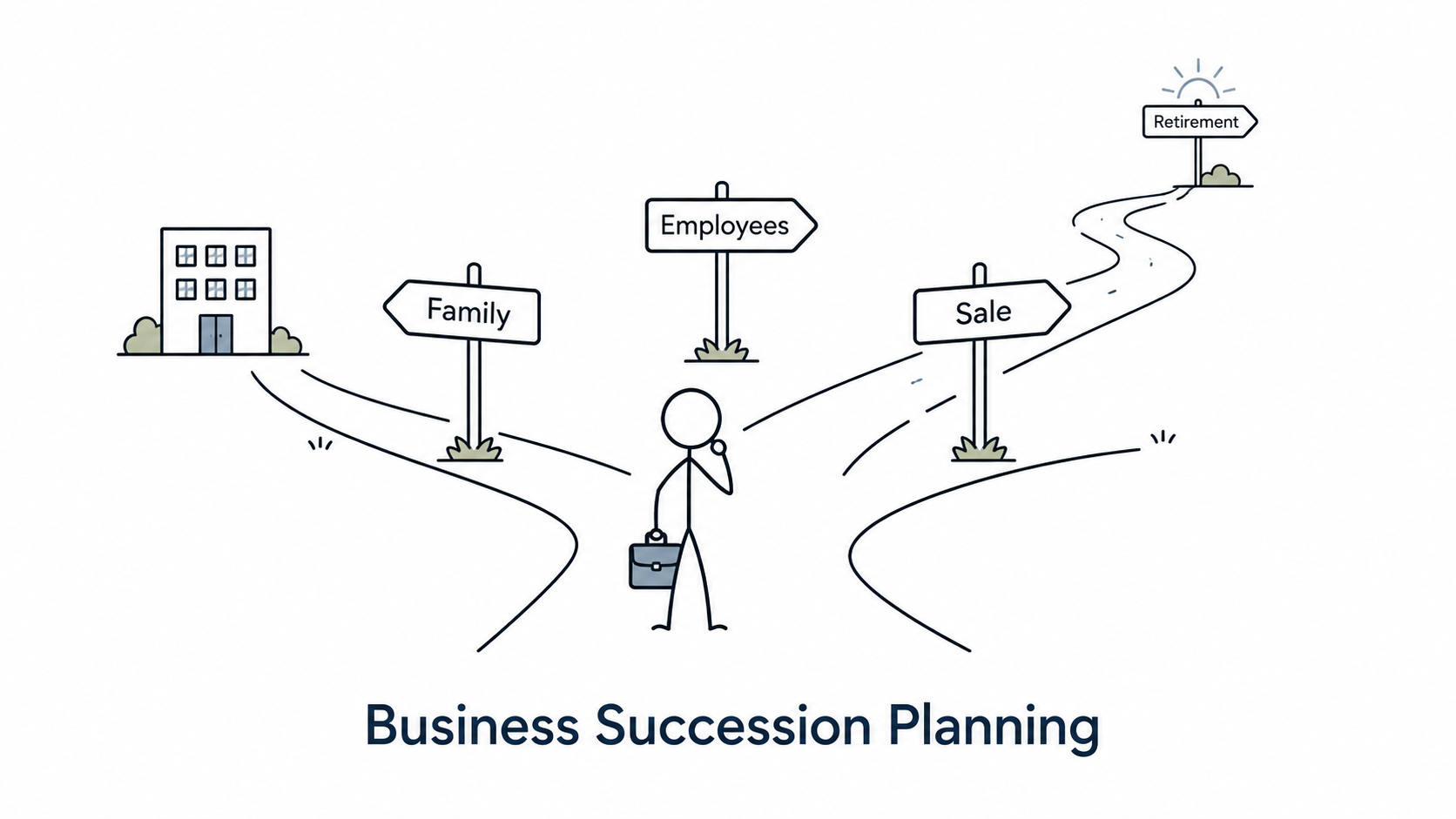
There are perhaps two broad types of business when we think about succession.
There is the family business that has been built over decades and perhaps already passed from one generation to another.
Then there is the first-generation business. You started it, took the risks, worked the long hours, employed the people and gradually built something of value.
The history may be different, but eventually, both business owners face the same question:
What happens when I am no longer running the business?
It sounds like a business question.
In reality, it is also a retirement question, a family question, a tax question and a financial planning question.
And it is probably better to start answering it several years before you intend to leave.
Succession is a process, not an event
It is easy to think about succession as a date in the diary.
“I'll retire at 60.”
“My children will eventually take over.”
“I'll sell the business in five years.”
But a successful business transition rarely happens on one particular day.
It is a process.
The Armstrong Watson Family-Owned, Privately-Owned and Owner-Managed Business Survey 2025, based on 858 responses, highlights why this matters. 68% of respondents intend to leave their business within the next 10 years, including 18% within two years. Yet 16% have not considered how they will leave.
That gap between wanting to leave and knowing how to leave is important.
A succession plan may need to consider the future management team, ownership, family members, business valuation, tax considerations, personal retirement needs, and what to do if the preferred route does not work.
Starting early creates options.
Leaving it until the point you want to retire can remove them.
The succession plan needs another person
One of the simplest questions is often overlooked:
Who actually wants the business?
You may assume that a son or daughter will eventually take over.
But have you asked them?
Armstrong Watson found that 34% of respondents already had the next generation in their business. Yet among those considering passing the business on, 61% had not discussed their intentions with the next generation.
That exposes one of the biggest weaknesses in succession planning.
A succession plan that exists only in the current owner's head is not really a succession plan.
Your children may love the business but not want to run it.
They may want to run it, but not yet have the experience.
One child may be heavily involved while another has chosen a completely different career.
And ownership and management do not necessarily have to be the same thing.
There are also questions around fairness. If one child has spent 15 years helping build the company while another has never worked in it, does dividing everything equally necessarily produce a fair outcome?
There is no universal answer.
The important thing is to start the conversation.
It is usually much easier to do those five or ten years before retirement than to do them five or ten months before it.
Your business can be part of your retirement plan, but should it be the whole plan?
Business owners understandably invest heavily in their businesses.
You know the company.
You control it.
And reinvesting profits may have produced attractive returns over many years.
The danger comes when the business gradually becomes almost the entire retirement plan.
We often hear the phrase:
“My business is my pension.”
Perhaps it will be.
But that creates a significant concentration of risk.
Your current income comes from the business.
A substantial part of your wealth may be in the business.
And your future retirement then depends on somebody being willing to pay the price you need for that business at roughly the time you want to stop working.
Armstrong Watson's findings make this particularly relevant. Nearly seven in ten respondents were aged 55 or over, while the most common exit routes were passing the business to family, closing it, or not yet knowing what they would do.
Not every succession route creates a large cash pot.
That means the question should not simply be:
“What is my business worth?”
It should also be:
“What do I need from my business to achieve the future I want?”
Those are very different questions.
What if the business is worth less than you think?
Imagine someone believes their business is worth £3 million.
Their retirement plan is straightforward:
Sell the company for £3 million, invest the proceeds and retire.
But what happens if the eventual offers are £2 million?
Or £1.5 million?
What happens if £1 million of the purchase price depends on an earn-out over the next three years?
What happens if the buyer wants the owner to remain involved?
Or there simply is not a buyer when the owner wants to retire?
The problem is not necessarily the business.
The problem is having no alternative.
Building pensions, ISAs and other investments outside the company can reduce that reliance. Armstrong Watson makes the same point in its report, arguing that a robust financial plan can help owners gradually extract profits and diversify their retirement strategy beyond the business itself.
That can provide something very valuable:
choice.
If your retirement is substantially funded without selling the business, you may be able to wait for the right buyer.
You might choose to transfer more to your children.
You could accept a phased sale.
You may decide to retain an interest.
Or you may negotiate from a stronger position because you do not desperately need one particular sale price.
Financial independence from the business can make business succession easier.
Financial planning and business planning are intertwined
For many business owners, personal financial planning cannot really be separated from business planning.
Before deciding how you want to leave the company, it helps to understand what you need personally.
When would you like to reduce your involvement?
What would you like retirement to look like?
How much income will you need?
What pensions, investments, property and cash do you already have?
How much needs to come from the business?
And what happens if the business sale produces less than expected?
Financial planning can model different outcomes.
Perhaps the business sells for £3 million.
What happens if it sells for £2 million?
Or £1 million?
What if you do not sell at all and instead transfer ownership to the next generation?
What if you stop working three years earlier?
A financial planner can help bring the personal numbers alongside the business strategy.
For a business owner, that can be much more useful than treating the company and their personal finances as entirely separate.
Can the business operate without you?
There is another useful test of succession readiness.
What happens if you do not turn up tomorrow?
If every major customer relationship belongs to the owner, every important decision requires their approval and crucial knowledge exists only in their head, there is a problem.
You may own a successful business.
But the business is also heavily dependent on you.
Armstrong Watson's research highlights how important knowledge and manual processes can become concentrated among a few individuals. It argues that more systemised and automated businesses can offer greater consistency, reliability and scalability, potentially making them more attractive to buyers.
Succession planning is therefore not simply about finding the next owner.
It is also about gradually building a business that no longer needs the current owner.
That might mean developing senior people, delegating client relationships, improving systems, documenting processes and gradually allowing somebody else to make decisions.
All of those things can make the eventual transition smoother.
They might also make the business more valuable.
What are the main business succession options?
There is no single correct route.
Broadly, most business owners are considering passing the company to family, transferring it to management or employees, or selling it to an external buyer.
Armstrong Watson found considerable variation: 21% expected to pass or sell to their children, 11% to other family members, 8% through a management or employee buyout and 4% through a change of structure such as an Employee Ownership Trust. Others expected to sell externally or simply cease trading.
1. Passing the business to family
For some owners, keeping the business in the family is the preferred outcome.
That may protect something which has taken decades to build.
But there is more to succession than transferring shares.
The next generation needs to be ready.
Management responsibilities need to be clear.
Where several family members are involved, there may need to be an agreement about who works in the company, who owns it and who makes decisions.
Tax planning also matters.
From 6 April 2026, 100% Business Relief for qualifying business and agricultural property is limited to a combined £2.5 million allowance per individual. An unused allowance can potentially transfer between spouses or civil partners, meaning up to £5 million could be available in some circumstances. Qualifying property above the available allowance generally receives 50% relief.
With the standard Inheritance Tax rate at 40%, 50% Business Relief can effectively leave qualifying value above the available allowance exposed to tax at 20%, before considering other allowances, liabilities and individual circumstances.
That is a significant change for some family businesses, particularly where much of the value is tied up in the company rather than held as cash.
There may also be Capital Gains Tax considerations when shares are gifted.
Gift Hold-Over Relief can potentially defer a capital gain when qualifying business assets or shares are transferred. Broadly, the donor does not pay the deferred gain immediately; it is reflected in the recipient's eventual disposal, subject to the conditions being met.
These are areas where financial planning needs to work alongside specialist tax and legal advice.
2. Transferring the business to management or employees
Sometimes the natural successors are already sitting around the management table.
A management buyout can offer continuity because the people purchasing the business already understand its clients, culture and operations.
Armstrong Watson found that only 8% of respondents currently expected a management or employee buyout. Its report also highlights an important practical point: management teams rarely have enough personal capital to fund the entire acquisition, so MBOs can involve a combination of bank funding, private equity, seller finance and management's own money.
Another potential route is an Employee Ownership Trust.
The tax position here has changed. For qualifying EOT disposals from 26 November 2025, half the gain is exempt from Capital Gains Tax and the remaining half is chargeable under the normal rules. This replaced the previous 100% relief.
Employee share schemes can also be useful before an eventual exit.
For qualifying companies, Enterprise Management Incentive arrangements can help recruit, retain and incentivise key employees. From 6 April 2026, the main EMI eligibility limits were widened for most qualifying companies, including increases in the gross-assets and employee thresholds.
Again, these are specialist arrangements.
But the wider point is straightforward:
Succession becomes easier if the people who may eventually own the business have already been given the opportunity to help run it.
3. Selling to a third party
For some owners, the preferred outcome will be an external sale.
That may be to a competitor, another business in the same sector, private equity or another investor.
If that is the plan, preparation should start well before the business goes to market.
A buyer will want to understand revenues, profitability, client concentration, contracts, staff, systems and how dependent the business is on the current owner.
This brings us back to the question:
Can the business operate without you?
The greater the dependency on one person, the harder it may be to achieve a clean exit.
Sale structure also matters.
A headline price of £5 million does not necessarily mean £5 million arrives in your bank account on completion.
There may be deferred consideration.
There may be an earn-out.
Tax will need to be deducted.
Some capital may remain at risk.
The financial planning number is therefore not simply the valuation.
It is what you will actually receive, when you will receive it and what that means for your future.
For qualifying disposals from 6 April 2026, Business Asset Disposal Relief provides an 18% Capital Gains Tax rate on qualifying gains within the £1 million lifetime limit, subject to the relevant conditions.
Succession planning should include a Plan B
Good financial planning should not depend on everything happening exactly as expected.
Neither should business succession planning.
What happens if your children do not want the company?
What if your chosen successor leaves?
What if the value of the business falls?
What if you cannot find a buyer?
What if you become ill before the succession is completed?
What if you decide you want to retire earlier?
Or tax rules change again?
These questions do not undermine the plan.
They test it.
A strong succession strategy should be able to adapt.
What happens to you after the business?
There is one final part of succession planning which can easily get forgotten.
You.
You may have spent 20, 30 or 40 years building the business.
Your week has structure.
People need you.
Customers call you.
Problems need solving.
Decisions need making.
Then one day they do not.
For some people that freedom is exactly what they have worked towards.
For others, retirement can feel surprisingly uncomfortable.
This is why we should not only ask:
“When are you retiring?”
Perhaps a better question is:
“What are you retiring to?”
You may remain as chair.
You might become a consultant.
You may mentor the next generation.
You might start another business.
Or you may want nothing more to do with work.
There is no right answer.
But the financial plan should support the life you actually want rather than assuming that selling the business is the end of the story.
Start before you need to
Business owners are naturally focused on their businesses.
Customers need serving.
Employees need paying.
Cash flow needs managing.
Growth needs funding.
Personal financial planning can therefore become something to deal with later.
The problem is that eventually later becomes now.
Armstrong Watson's research shows that more than two-thirds of the business owners surveyed expect to leave within ten years.
For those owners, succession planning is no longer a distant issue.
Building assets outside the company can reduce reliance on a future sale.
Talking to family or management early gives potential successors time to prepare.
Making the company less dependent on its current owner may protect and potentially enhance its value.
Tax and legal planning can reduce the risk of surprises.
And financial planning can answer perhaps the most important question:
What do I actually need from my business to make the next stage of my life possible?
A successful business succession is not simply about transferring shares from one person to another.
It is about protecting what you have built, preparing whoever comes next and making sure you can move confidently into whatever comes after the business.
The earlier you start, the more choices you are likely to have.
Frequently asked questions
When should I start business succession planning?
Ideally, several years before you intend to leave. Preparing successors, reducing dependence on the owner, improving systems, considering tax and building personal retirement assets all take time.
Can I rely on selling my business to fund retirement?
A business sale can be an important part of retirement planning, but relying entirely on one future transaction creates risk. Building pensions, ISAs and investments outside the company can provide greater flexibility if the timing or value of the eventual sale differs from expectations.
Can I pass my business to my children?
Potentially, but ownership, management, family expectations and tax all need consideration. The starting point should be determining whether the next generation actually wants the business and is ready to take responsibility for it.
What is Business Relief in 2026?
From 6 April 2026, qualifying business and agricultural property can generally receive 100% relief on a combined value of up to £2.5 million per individual, with unused allowances potentially transferable between spouses or civil partners. Qualifying value above the available allowance generally receives 50% relief.
What are the main business exit options?
Typical routes include passing the company to family, completing a management buyout, transferring ownership through an Employee Ownership Trust, selling to an external buyer or, in some circumstances, closing the business. Which route is appropriate depends on the business and what the owner wants to achieve.
Important note
This article is distributed for educational purposes only and should not be considered investment advice or an offer of any security for sale. This article contains the opinions of the author but not necessarily the Firm and does not represent a recommendation of any particular security, strategy, or investment product. Reference to specific products is made only to help make educational points and does not constitute any form or recommendation or advice. Information contained herein has been obtained from sources believed to be reliable but is not guaranteed.
Article Written: August 2026, Tax Rates and Allowances May Change In The Future.